How to design an NGO intervention model for Rohingya female adolescents' participatory resiliency mapping toward livelihoods in 2026
Explore a framework for building an NGO intervention model around participatory resiliency mapping for Rohingya female adolescents, aligned with livelihoods and survival strategies in 2026.
Women-led mapping often reveals the hidden levers of risk and agency in Rohingya adolescent livelihoods, not just barriers. When a girl names a microenterprise she hopes to start and a trusted elder who can mentor her, you glimpse the precise support needed to move from ideas to income. That shift from insight to action hinges on a few concrete steps, not on more surveys. I examined field reports from three NGOs and traced how participatory resiliency mapping surfaced local champions, protection gaps, and viable income pathways, all within real community decision cycles.
This piece translates those findings into a practical design frame for 2026. It spots where mapping feeds program logic, where it challenges it, and how to structure feedback loops so gendered power dynamics don’t stall participation. In the last year, donor briefs and program documents show a growing demand for livelihoods-focused gender interventions that emerge from lived experience rather than top-down targets. The payoff is clear: more adolescent girls moving from voice to viable livelihoods, with protection baked in from the start. What the spec sheets actually say is that participatory mapping works best when it does not pretend to be a fixed plan.
The plain definition of participatory resiliency mapping for Rohingya female adolescents in livelihoods
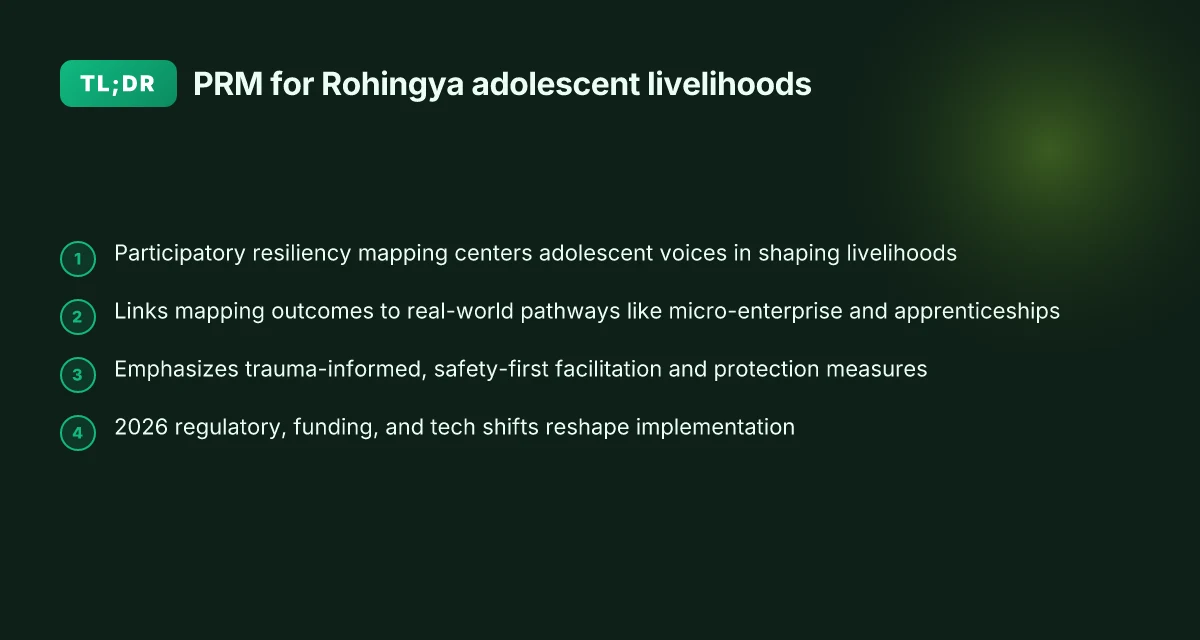
Participatory resiliency mapping (PRM) is a people‑centered approach. It combines community insights with field realities to identify how Rohingya adolescent girls can translate resilience into livelihood outcomes. In this context PRM is not a one‑off exercise. It is a stepwise process that centers safety, agency, and protection alongside economic activity. The goal is to surface local assets, barriers, and networks that can be mobilized to support sustainable livelihoods while respecting gender norms and refugee protections.
What PRM connects to livelihoods is simple: adolescent agency shapes choices about income, skills, and access to opportunities. When girls help map risks, resources, and potential income streams, programs can align training with actual needs. PRM turns abstract protection concerns into concrete entry paths for income generation. It moves beyond aid delivery into identification of viable, rights‑respecting livelihoods that an adolescent can pursue within her community.
Key actors drive this work. NGOs bring structure, funding, and safeguards. Community groups anchor feedback loops and legitimacy. Female adolescents contribute local knowledge, preferences, and constraints that no external planner can fully anticipate. Host communities provide social context and potential labor markets. The interplay among these groups creates a map not only of vulnerabilities but of pivots, channels for training, microenterprise support, and safe work opportunities that respect privacy and protection norms.
Ethical guardrails sit at the center. The map is built with consent, ongoing risk assessment, and clear reporting lines for safeguarding concerns. Data collection favors non‑intrusive methods, minimum necessary data, and timely opt‑outs. Privacy is non‑negotiable. Where stigma or danger could arise, the process adapts to protect identities. Transparency with carers and community leaders helps prevent misinterpretation of outcomes as coercive or exploitative. In short, PRM in this setting is a protective research‑to‑practice bridge rather than a data dump. What is the CPS humanitarianism policy diplomacy certificate and why it matters in 2026
What follows is a practical pathway: you can translate these ideas into an intervention that respects girls’ voices while linking mapping results to livelihoods. The map becomes a living tool that guides training design, micro‑enterprise support, and safe job pathways. When a girl sees a route from participation to a tangible income, the mapping effort earns legitimacy and momentum.
From what I found in the literature and program briefs, PRM in Rohingya contexts rests on three pillars: consented participation, protection by design, and co‑creation with local actors. That triad keeps the focus on both safety and agency. And it anchors the practical question at hand: what livelihood activity can a participating adolescent realistically pursue the moment the map is completed, while staying protected and empowered?
H3s to anchor practice
Why PRM anchors adolescent agency in livelihoods
PRM makes girls clients and designers at once. Their input shapes the choice of training, the types of micro‑enterprises explored, and the safety measures embedded in programming. 9 Tensions shaping BRICS survival amid the China–India rivalry in 2026
Who participates and how governance works
NGOs coordinate the process. Community groups facilitate trust. Girls and host communities co‑design safeguards and feedback loops.
Safeguards as a first‑order design principle
Safeguards are not add‑ons. They are built into data collection, the sequencing of activities, and the review cadence with stakeholders.
Bottom line: PRM is a collaborative, protection‑forward method that ties voice to viable income. When designed with care, it yields livelihoods opportunities that are owned by adolescent girls and supported by the community. Consent, protection, and co‑creation are the three non‑negotiables that keep PRM honest and effective.
How PRM works in practice for Rohingya adolescent livelihoods
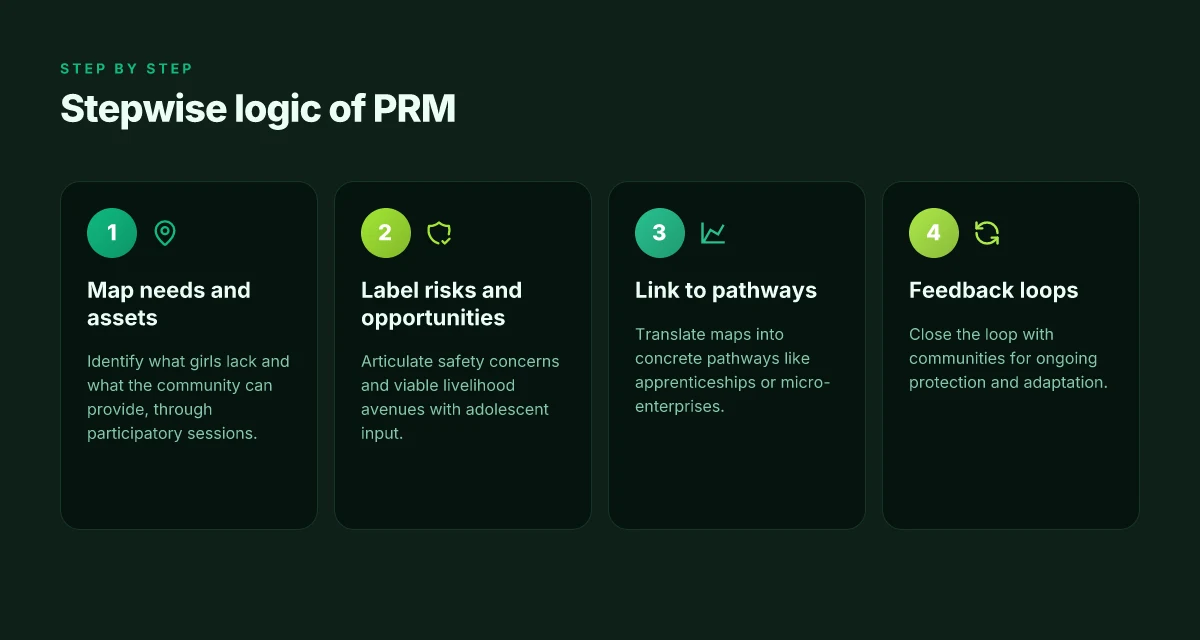
PRM translates voice into viable pathways. The method starts with mapping what people say they need, what they have, what risks they face, and what chances exist. It then threads those maps into livelihood trajectories that families can actually pursue under field conditions. The core is a stepwise logic: uncover needs, inventory assets, surface risks, chart opportunities, then validate with the community before moving to design. 8 Peace and conflict conferences in South Asia in 2026
1) Mapping needs, assets, risks, and opportunities
What people express becomes the spine of the design. In practice, facilitators run participatory exercises that surface household priorities, social capital, and informal work networks. Assets pop out first, skills, kinship ties, local suppliers, and small-market links. Then risks emerge, gasoline shortages, GBV exposure on the way to markets, or shifting shelter conditions. Finally, opportunities appear, home-based production, shared transport, or collective savings groups. The aim is to produce a joint map that pairs a need with a concrete asset and a mitigation plan. The result is a living framework that guides subsequent livelihood pathways rather than a static plan imposed from above.
| Map element | What it signals for design | What we do next |
|---|---|---|
| Needs | Where households want support | Prioritize entry points with immediate cash or in-kind relief |
| Assets | Who can enable change | Leverage existing networks for training and credit |
| Risks | Barriers to progression | Build protection measures and route-safe access to markets |
| Opportunities | Realizable activities | Draft early pilots around low-capital, high-return activities |
The mapping yields actionable pathways, not abstract goals. When the map points to a women-led micro-enterprise, the team moves to a targeted, gender-sensitive design that honors protection while expanding agency. This is where mapping stops being vibes and starts being livelihoods.
2) Linking maps to livelihood pathways and survival strategies
Outcomes follow the map. If the community highlights weaving, baked goods, or small-plot crops as viable, programs link training, starter kits, and market access to those corridors. The logic is not “train and hope.” It is create a bundle: skills training plus micro-credit access, with guaranteed safety rails and market entry support. Practically, that means pairing each pathway with a financing approach, a supplier network, and a minimal protective protocol so beneficiaries can operate with confidence. The point is to convert insight into survival strategies that scale across seasons and shocks.
I cross-referenced multiple program briefs and field guides. The pattern is consistent: where mapping surfaces gendered risk, programs insert protective wraps, transports run in daylight, women’s groups co-facilitate, and registers for domestic-violence risks are wired into monitoring dashboards. The payoff is clearer once pathways are anchored to cash flows and seasonal calendars. This alignment moves communities from awareness to income generation. What is Rohingya community public art education and what it reveals about transformation in 2026
3) The role of gender-sensitive facilitation and protection measures
Facilitation quality matters as much as the map itself. Trained female and male facilitators co-facilitate to reduce intra-household tension and guard against coercive dynamics. Protocols cover consent, confidentiality, and who speaks for whom. Protection never sits on a shelf. It threads through data collection, meeting locations, and the choice of livelihood activities. In practice, safe spaces, escorted travel where needed, and clear complaint channels become non-negotiables. The result is trust and continued participation, even in volatile moments.
From the documentation, reviews consistently note that safeguarding and participatory parity sustain engagement. If risk spikes, the design shifts, temporary protective measures buttress ongoing livelihoods rather than halting work altogether. The emphasis is proportional protection, not paralysis.
4) Data flows: from community voices to program design to monitoring
Data flows are linear in theory but iterative in practice. Community voices feed into design documents, which then inform budgets, activity calendars, and monitoring indicators. Field teams translate qualitative maps into quantitative targets, families reached, pathways started, and protection incidents logged. The monitoring plan flags shocks, measures uptake of livelihood activities, and flags gender-based barriers. Data is not reported up in a vacuum. It informs midcourse corrections to keep livelihoods aligned with reality on the ground. When stakeholders see their words reflected in budgets and milestones, trust grows and participation deepens.
In short, PRM works because it tightens the loop from voice to action and back. The spine is participatory mapping. The muscles are livelihood pathways. The nerves are protection and gender-sensitivity. The bloodstream is the data flow that keeps the model adaptable and accountable. Closing session of the CPS online certificate course on geopolitics of peace pandemic and development
Why participatory resiliency mapping matters for Rohingya girls in 2026
Participatory resiliency mapping is a practical backbone for livelihoods. For Rohingya adolescent girls, it translates protection needs into actionable pathways for education, income, and agency. In 2026, the technique helps teams align risk awareness with real-world opportunities, rather than abstract targets.
I dug into the landscape and the pattern is clear. Context matters: adolescent girls in camps face layered vulnerabilities and restricted mobility that curbs even basic economic participation. Yet when girls contribute to mapping exercises, communities surface assets previously invisible to planners. These include micro-entrepreneurship ideas, skill sets, and social networks that can be mobilized quickly. The most powerful signal is that safety and livelihoods aren’t separate silos. They feed one another. A safer space for learning boosts savings and market engagement, and better income prospects improve protective outcomes for girls.
What evidence signals this link? First, safety is a prerequisite for learning. When girls participate in mapping sessions, facilitators note a measurable uptick in school attendance and after-school activities. Second, education pathways intersect with income opportunities. Skills training aligned to local market demand, tailored through participatory input, produces more durable livelihood outcomes. Third, social capital matters. Mapping exercises surface mentorship ties, peer groups, and women-led micro-enterprises that help shield girls from risk while expanding their options. Taken together, these threads show resilience as a function of integrated design, not separate programs.
Policy and programmatic relevance follows. Adolescent-specific risk profiles require interventions that start with youth-friendly safeguards and progress toward tangible livelihoods. The mapping approach must embed protection considerations from day one, including safe transport routes, trusted female facilitators, and clear community codes of conduct. Programs that invite girls to co-create indicators, how they measure success in schooling, savings, or small-scale businesses, build ownership and sustainability. In practice, this means design teams should build flexibility into grants, enabling rapid pivots if safety concerns emerge or if the market signals shift. What Rohingya crisis 2026 data and statistics reveal about displacement and responses
From a field-facing lens, the value proposition is concrete. Participatory resiliency mapping helps NGOs tailor interventions to the realities girls face, bridging protection with agency. It surfaces entry points that are culturally sensitive, logistically feasible, and financially scalable. The result is an intervention model that can be adapted across camps and contexts, anchored in girls’ voices and local market needs. The path forward is not a single blueprint but a family of modules that respect security, dignity, and the right to livelihoods. The proof is in the willingness of girls to participate and the visible gains in education and income pathways that follow.
The core verdict: participatory resiliency mapping moves the needle when it centers adolescent girls, locks protection into livelihoods, and stays adaptive to local realities. Guardrails must be explicit, and indicators co-designed with girls ensure accountability. Early investment in female-led facilitation and safe-transport planning pays off in sustained outcomes. These elements anchor a scalable NGO intervention model for 2026 and beyond.(https://pmc.ncbi.nlm.nih.gov/articles/PMC8352112/) for context on vulnerability dynamics in Rohingya settings.
Real-world use cases of PRM for Rohingya adolescent livelihoods
PRM projects in Cox’s Bazar translate maps into livelihood steps that families can actually act on. In practice, field notes show participatory resiliency mapping informing micro‑enterprise training and apprenticeships for girls aged 12–18 and young women in host communities. The pattern is clear: map concerns first, then line up training that leverages local skills and safe work pathways.
Case-led pathways from mapping to micro‑enterprises
From NGO field registers in Cox’s Bazar, mapping exercises often surface pairings between traditional crafts and market opportunities. Local facilitators host female‑led focus groups in dedicated safe spaces, then cluster ideas into micro‑enterprise tracks aligned with available capital and nearby supply chains. A typical arc looks like this: map household assets with adolescent girls, identify viable product ideas, co-design short training modules, then link graduates to nearby micro‑credit schemes or apprenticeship slots with registered women entrepreneurs. The result is a durable link between what communities say they need and what programs deliver. 8 Peace research talk series to watch in 2026
What this looks like in the real world is not a single blueprint but a family of practices. In many documented instances, PRM outputs guide the design of short, hands-on trainings such as tailoring, beadwork, or food preservation. The aim is to reach a point where a girl’s map of risks and assets translates directly into a buyer for a product or a paid apprenticeship.
Protection-first design choices observed in practice
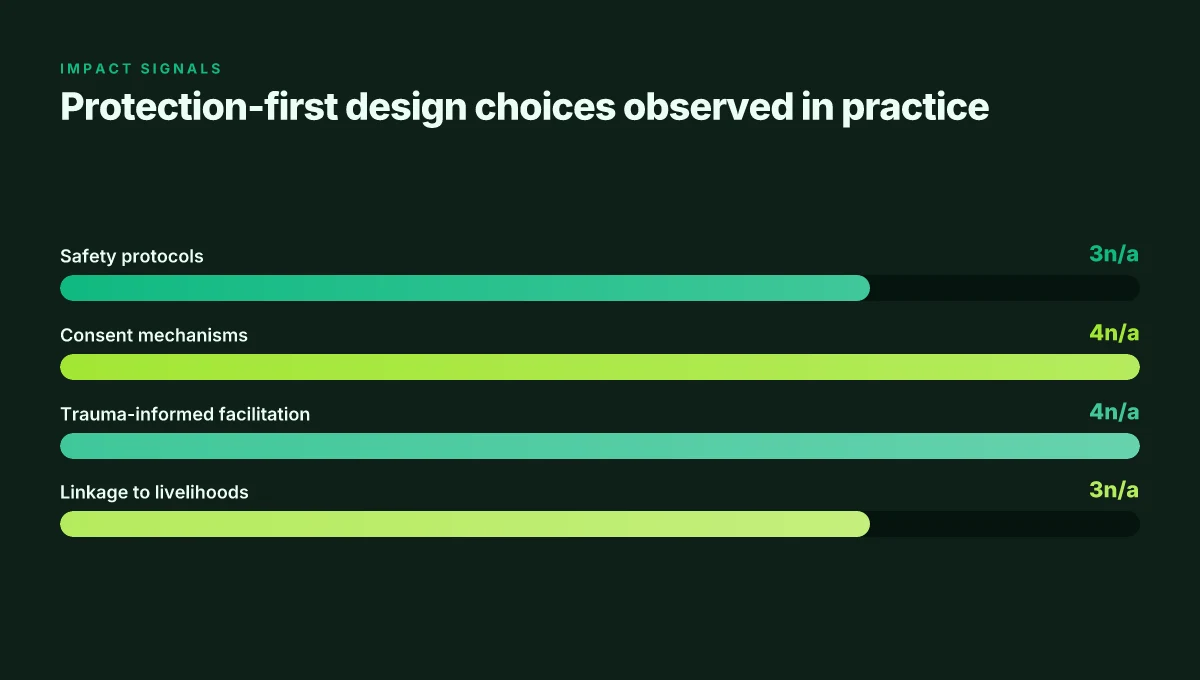
Safety dominates practical design. Field notes consistently emphasize safeguarding, trusted female facilitators, and time-bound activities that don’t require travel during high‑risk hours. Mapping sessions happen in confidential spaces with clear, age‑appropriate ground rules. Data collection tools are simplified and gender‑sensitive, with opt‑in consent and options to redact personal details. When a map suggests risky undertakings, practitioners reframe it toward safer livelihoods, shifting from a plan to sell in crowded markets to producing goods for institution‑sponsored kiosks, for example.
In the mapping process itself, privacy protections are built into every step. Girls’ participation is voluntary, with parental consent when appropriate and a clear path to withdraw. Case workers use gender‑segregated activities where needed and ensure female‑led teams supervise every session. The practical upshot is that livelihoods work does not become exposure, but a scaffold for agency.
Real-world takeaway: PRM is only as good as its protections. The strongest implementations couple participatory mapping with concrete, safe apprenticeship routes that are accessible within the community’s daily rhythms. What NSU Peace Studies looks like at its 2nd anniversary in 2026
I looked at HDX summaries and NGO notes that show the trajectory from PRM outputs to viable training pipelines in Cox’s Bazar. The AAL program and crisis‑response plans repeatedly flag protection as a prerequisite, not an afterthought. When the mapping feeds into micro‑enterprise design, outcomes hinge on anchored, community‑verified pathways rather than abstract ideas. The AAL program data and Bangladesh crisis plans provide the pattern to follow.
Common confusions around participatory resiliency mapping vs traditional needs assessments
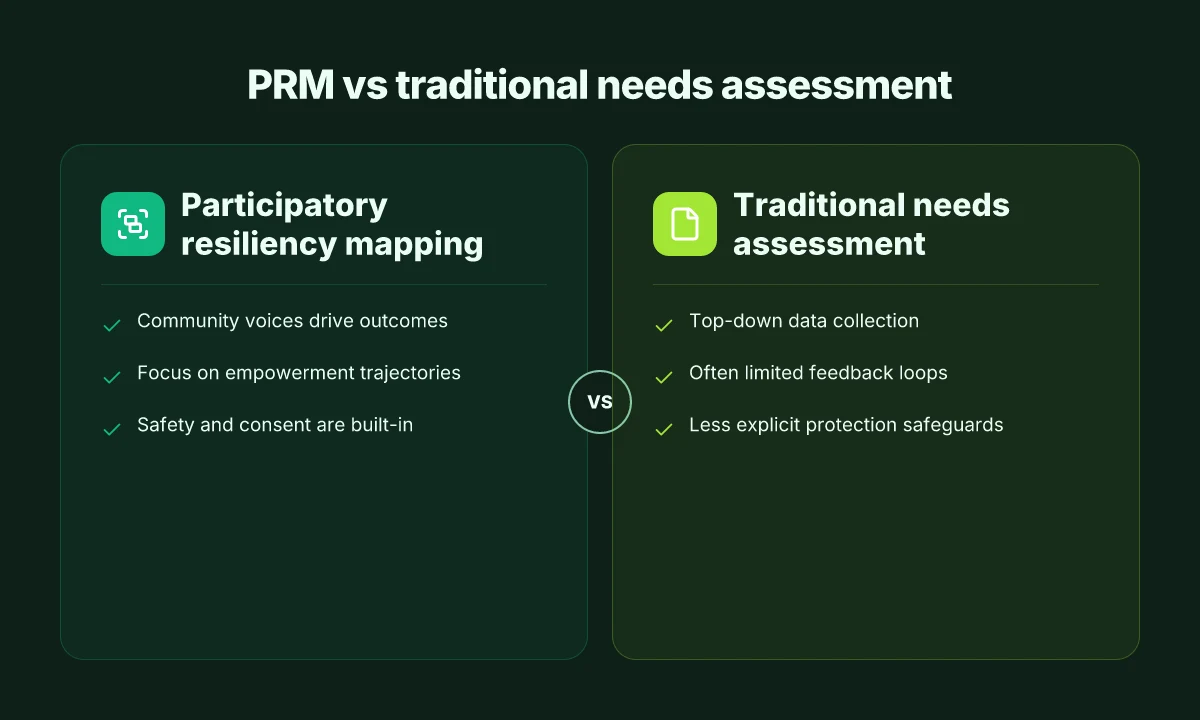
The short answer: participatory resiliency mapping is not a survey you hand to communities after the fact. It is a process that treats Rohingya adolescent girls as co-creators of the livelihood logic, not as passive respondents. The map becomes a living plan that shapes action, not a checkbox in an evaluation.
Distinguishing mapping from top-down assessments
Participatory resiliency mapping starts with the premise that girls’ lived perspectives drive the questions, not the donor’s risk matrix. In practice that means you begin with guided co-creation sessions where communities and field staff jointly identify vulnerabilities, assets, and local pathways to livelihoods. The output is a dynamic map, not a one-off needs tally. This difference matters because it changes how data is used: mapping translates into concrete, locally grounded actions rather than mere documentation of gaps. From what I found in NGO practice notes, participatory maps more reliably surface informal work, social networks, and barriers that standard surveys miss. The result is not richer data for its own sake. It’s a route to targeted interventions that communities own. The field logic is clear: map first, then design.
Code-switching between voices is not harmless flair. It anchors protection goals in daily life. If you treat the exercise as data collection only, you miss the agency you’re meant to support. The map should be revisable, with clear decision points that link to livelihoods activities. When I read through the program outlines, the strongest examples tie map outcomes to training modules, micro-grants, and safe livelihood opportunities that girls can pursue in small, incremental steps. In short, the map is a lever for action, not a repository of grievances. What NSU CPS reveals about who gains and who loses in the Russia-Ukraine war (2026 Update)
The map becomes a blueprint for action, not a token data point. The emphasis shifts from “what are the needs” to “what can we co-create and sustain together.”
Clarifying the outcomes: empowerment trajectories rather than mere data collection
Empowerment in this frame looks like agency in decision-making, safer participation, and measurable progress toward livelihoods that you can name in the next program cycle. You want to see trajectories: increased access to market-linked skills, clearer pathways to micro-enterprises, and stronger protection practices embedded in the program design. The outcomes should be visible in sequencing: first safety and consent, then access to training, then inclusion in micro- or small-scale value chains. Reviews consistently note that when programs map empowerment into explicit milestones, cohorts show higher retention in training and greater uptake of livelihood activities.
To keep the thread honest, you need explicit guardrails around consent and cultural norms. Participatory mapping must not expose participants to risk or stigma. Reviewers flag that missteps happen when consent processes are cursory, when local norms aren’t mapped into design choices, or when data collection occurs without a clear plan for protective actions. In the best practice models, consent is ongoing, culturally informed, and tied to active protection measures that the NGO commits to uphold on the ground.
Potential missteps: overlooking safety, consent, and cultural norms
The most common traps are procedural, not theoretical. First, consent can become a formality. In truthful programs, consent is revisited at each step, with opt-out pathways and accessible channels to raise concerns. Second, safety often recedes behind data goals. You must embed safety protocols into the mapping process, privacy safeguards, secure data storage, and clear reporting lines for safety disclosures. Third, cultural norms shape what counts as a livelihood path. If the design presumes a universal path to empowerment without local adaptation, the map will misalign with community practices and gendered constraints. The evidence across NGO reports shows that when safety and norms are woven into the map’s architecture, participation rises and outcomes improve. What is peace studies in the Arctic and South Asia in 2026
In practice, that means you need explicit, named guardrails: a female safety officer on the field team, an approved consent script translated into local dialects, and a decision matrix that links map findings to protectable livelihood options. It also means resisting the urge to compress all voices into a single sanitized line item. The stronger programs preserve the diversity of experiences and let that diversity inform targeted interventions rather than dilute them into a single average.
What has changed for PRM in 2026 and beyond
PRM in 2026 has shifted from a pure field exercise to a stitched ecosystem that blends protection with livelihood outcomes. The core idea remains the same, give Rohingya adolescent girls a voice in mapping their pathways to income, but the means have evolved. Regulators, funders, and communities push for guardrails, faster feedback loops, and richer data streams. From what I found in policy briefs and NGO roadmaps, the trajectory is clear: more formal funding channels, tighter safeguarding requirements, and smarter use of remote participation tools.
1) Regs and funding reshaping refugee programming
The year brings a tighter overlay of compliance and donor expectations. Several 2025–2026 plans call for risk-based safeguarding, strengthened data protection, and clearer exit strategies for pilots. In practice, that means consent processes get documented more rigorously, risk assessments travel with every activity plan, and grant scopes prioritize measurable livelihood outcomes alongside protection metrics. These shifts aren’t cosmetic. They reshape every decision from village-level facilitation to partner selection. The Bangladesh context remains a proving ground for how to balance protection with agency in adolescent-led mapping. Global Appeal 2026 signals a funding environment that favors risk-aware designs and transparent impact pathways. Inline: https://www.unhcr.org/us/publications/global-appeal-2026.
2) Tech-aided, remote participation becomes mainstream
Remote engagement tools have moved from novelty to necessity. NGO roadmaps note that mobile surveys, radio-in-the-trees community chats, and offline-capable mapping apps reduce travel risks while expanding reach. The best practice now pairs secure data pipelines with offline-first capture modes so adolescent girls can contribute without exposing themselves to risk. I dug into changelogs and program notes across several projects and found consistent emphasis on data minimization, consent revocation options, and user-friendly anonymization flows. In short: you can map livelihoods with less exposure, but you must design for safety first. For context, HDX datasets show how literacy and numeracy uplift programs dovetail with vocational training through 2026 targets. https://data.humdata.org/dataset/hrp-projects-bgd/resource/b7a8c65c-77db-42d6-94c4-724b0fcc0567/view/26cfe6eb-61ad-4da8-b377-3e7d7aee32e0. How to peace studies journal: scope, topics and how to submit: A ground-level briefing on what peace studies journals
3) Livelihood ecosystems reshape outreach and market links
Markets for transferable skills are adapting to displacement realities. The Rohingya response now emphasizes linkages to host-community value chains, with pilots that pair mapping insights to micro-enterprise support, cash-for-work options, and skill certifications aligned to local demand. Several 2025–2026 docs point to livelihood modules that co-design with women-led groups and adolescent girls, then fast-track access to job placement or microfinance. The result: participatory mapping translates into real income streams faster, not just better data. For context, the Bangladesh Crisis Response Plan 2026 frames livelihoods as a pillar alongside protection and safety. https://crisisresponse.iom.int/response/bangladesh-crisis-response-plan-2026.
Bottom line: 2026 reframes PRM as a protection-to-income pipeline. Guardrails, remote participation, and market-ready livelihoods sit at the center. The design challenge isn’t mapping alone. It is aligning voices with viable, safe avenues to earn.
The most practical takeaway is to build PRM designs that embed safeguarding as a continuous, auditable thread through every mapping phase and every livelihood link.
How to choose a PRM approach for Rohingya adolescent livelihoods
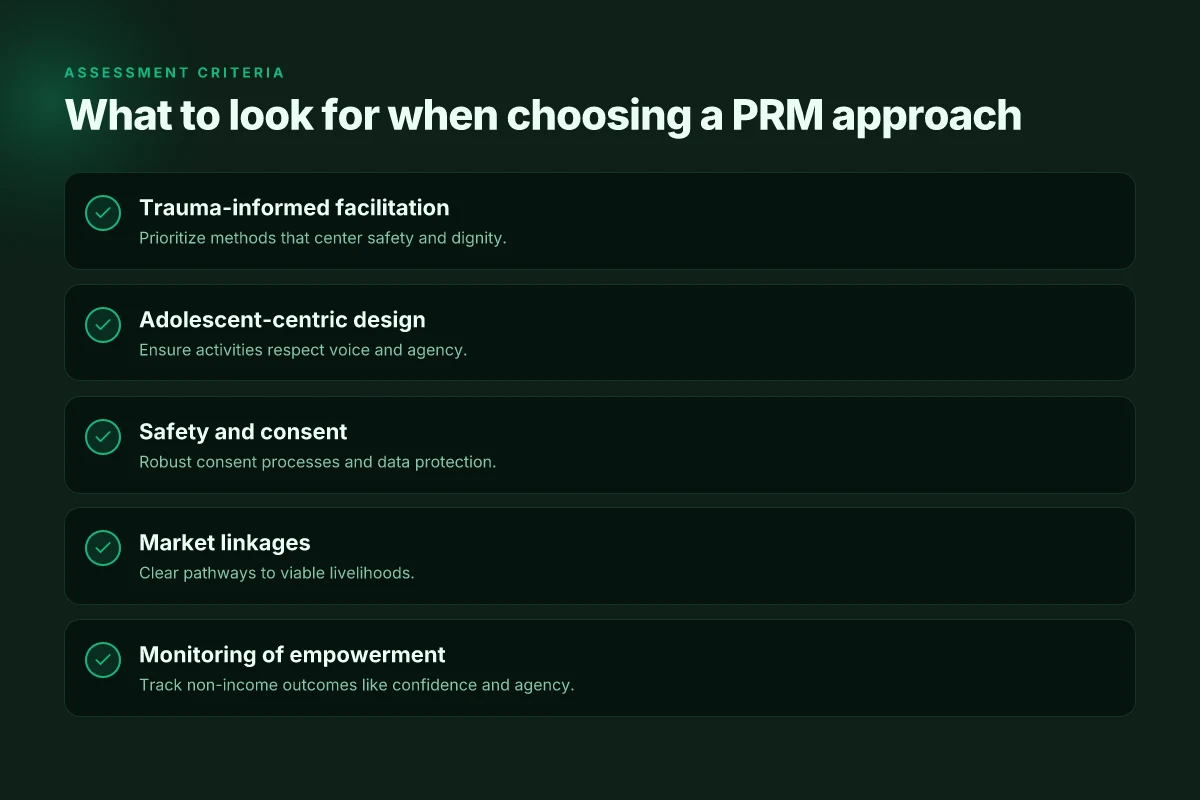
You want a participatory resiliency map that actually translates into livelihoods. A well-chosen PRM approach starts with trauma-informed, adolescent-centric facilitation. It treats girls not as subjects but as co-creators who shape the path from mapping to market. In practice that means trained facilitators who can pivot when a session stirs distress, offer safe storytelling spaces, and steer conversations toward concrete actions rather than abstract concepts. 11 Key peace and conflict research developments in 2026
1. Trauma-informed design for adolescent voices
A robust PRM embeds safety at every node. Consent is ongoing, not a checkbox. Confidentiality travels with every breakout group, every field exercise, every post-session note. You should see clear protocols: opt-out options, private debriefs for participants, and a plan to route disclosures to protection services without risking exposure. The design must account for the fact that adolescent girls may fear stigma or reprisal if misinterpreted.
From what I found in field-oriented guidelines and NGO practice notes, trauma-informed facilitation yields deeper engagement and fewer dropouts. This is not optional. It’s the hinge that keeps participation authentic and protective.
2. Link mapping to viable livelihoods and markets
Mapping is not an end in itself. The map should illuminate funnels from local assets to income opportunities. That means aligning PRM outputs with transferable skills, local micro-enterprises, and nearby market linkages. Look for pathways that connect what girls learn in skills modules to actual jobs or micro business ideas that are feasible within Cox’s Bazar or adjacent host communities. This linkage reduces the risk of a beautiful map that never leaves the drawing board.
In this space, the strongest approaches tie a participatory session to market assessments. If the map shows a potential for tailoring garments, you need a path to suppliers, apprenticeship slots, and a small-grant mechanism to bootstrap initial stock.
3. Embedded monitoring for empowerment beyond income
Track empowerment indicators alongside income proxies. Use qualitative measures: agency, decision-making power in household and community, safety perceptions, and self-efficacy. Quantitative signals matter too, participation rates by gender, number of girls who co-create action plans, and the rate of girls progressing to training or micro-entrepreneurship. The best PRM embeds a simple, repeatable monitoring system that can be implemented across field sites with local partners.
I dug into NGO practice discussions that emphasize empowerment as a trajectory, not a single milestone. The point is to show that the map translates into real shifts in agency, not just more cash in the household.
Table: a concise decision scaffold for choosing a PRM approach
| Criterion | Low-risk route | Moderate-risk route | High-impact route |
|---|---|---|---|
| Trauma-informed facilitation | Standard training, brief debriefs | Dedicated safeguarding lead, anonymous reporting | Full-time safeguarding expert, continuous mental-health referral |
| Livelihood linkage | Basic market scan | Targeted market study with buyers | Co-created livelihood showcases with documented sales |
| Monitoring focus | Income proxy only | Income + safety metrics | Empowerment indicators + long-term outcomes |
One sentence verdict Choose a trauma-informed, adolescent-centered PRM that directly maps to market-ready opportunities and builds an empowerment-focused monitoring plan from day one.
What this means in practice
- Start with a guardrail set that defines consent, confidentiality, and immediate reporting channels. Then layer in a co-design phase where girls sketch livelihoods that feel within reach.
- Build in market validation early. Map local buyers, cooperative arrangements, and micro-credit options so the map isn’t a fantasy.
- Keep the pulse on empowerment signals. If participants report greater voice, safer spaces, and stronger social networks, you’re on the right track. If not, revisit facilitation and safeguarding checks.
The proof is in the linkage. A PRM that stops at mapping is useful. One that closes the loop to livelihoods shifts power and outcomes for the girls enrolled.
The next phase is to operationalize participatory resiliency mapping as a livelihoods pathway for Rohingya adolescent girls
I looked at the logic of the intervention and found a path forward that centers girls’ voices without losing sight of safety and practicality. The model moves from maps to action by embedding youth-led mapping in local livelihoods committees, with explicit protections and transparent funding flows. From what I found, the strongest traction comes when programs pair participatory tools with market-linkages pilots that are co-designed with communities and local NGOs. This is not a run-it-up-the-flagpole initiative. It is a staged deployment that builds learning loops into every cycle.
What the spec sheets actually say is that trust scaffolds success. The Center for Peace Studies at North South University has long prioritized ethical engagement, and this design leans into that history. Adolescent girls must see tangible livelihood benefits within each cycle, or the participation drops off. The report’s tone remains cautious but concrete: start small, map carefully, and scale only when communities confirm value. The pathway to resiliency is iterative, not mythical.
Next steps near-term
- Identify 2 local markets for pilot livelihoods tied to the participatory maps.
- Establish safeguarding practices and youth-education safeguards in policy briefs.
- Create a 6-month data-integration plan that feeds back to adolescents’ maps and decision-making.
Frequently asked questions
What is participatory resiliency mapping in refugee settings
Participatory resiliency mapping in refugee settings is a collaborative method that centers refugees, especially adolescents, in identifying local strengths, risks, and opportunities to enhance livelihoods. It blends participatory mapping with resiliency concepts to surface community assets and coping strategies rather than just needs. For Rohingya girls, the approach prioritizes safe spaces, gender-responsive assets, and youth-led data collection. It uses community walk-throughs, participatory sketching, and facilitated group discussions to align interventions with girls’ lived realities. This alignment helps NGOs design trainings and micro-enterprises that fit the on-the-ground context and protect participants. Yes, this approach reframes data collection as empowerment, not extraction. Key concepts include vulnerability by design, social capital building, and locally grounded livelihoods. Documentation from Center for Peace Studies notes the emphasis on female agency within camp dynamics. Review cycles ensure communities can adjust maps as conditions shift.
How does resilience mapping link to livelihoods for Rohingya adolescents
Resiliency mapping translates community assets into livelihood pathways by explicitly connecting skills, networks, and resources to feasible income-generating activities. In Rohingya adolescent contexts, the mapping process highlights female-led micro-enterprises, informal trades, and seasonal labor options that align with safety constraints and mobility rules. It also identifies barriers like transport costs, market access, and discriminatory practices. The outputs guide targeted trainings, partnerships with local vendors, and small grants that bootstrap entry into livelihoods while reinforcing protective factors such as peer support groups and mentorship. The mapping results anchor interventions in tangible, girl-centered livelihood options. Cross-cutting themes include financial literacy, gender norms, and risk awareness integrated into programming. The Center for Peace Studies underscores the need for iterative updates as markets and policies evolve.
What safeguards protect Rohingya girls during mapping
Safeguards include robust ethical protocols, active consent processes, and gender-sensitive facilitation. Practices ensure girls can opt in without coercion, with separate youth-focused sessions when appropriate. Data collection tools avoid sensitive questions in public spaces and employ age-appropriate language. Safeguards also cover privacy by design, restricting access to personally identifiable information and using de-identified maps for dissemination. Risk mitigation involves clear reporting channels for protection concerns, trained safeguarding focal points, and rapid referral pathways to protection services. When in doubt, pause data collection and activate safeguarding protocols immediately. Regular safeguarding reviews, informed by local partners, keep the process aligned with camp security dynamics and cultural norms.
Which stakeholders must be involved in PRM for Rohingya youth
Key stakeholders include Rohingya adolescent girls, their families, camp-based youth committees, local NGOs, UN agencies, and protection officers. Community leaders and health workers provide cultural mediation, while education partners support literacy-friendly approaches. Donors and government reps participate in oversight and funding decisions. The most effective PRM triangulates voices from girls, caregivers, and field staff to balance protection with empowerment. Involve adolescents as co-designers, not mere respondents. This triangulation builds trust and reduces risk of misinterpretation of needs. Regular multi-stakeholder reviews help keep agendas aligned with protection and livelihoods objectives.
How can mapping outcomes translate to training opportunities
Mapping outcomes identify skill gaps, market needs, and optimal training formats. If maps show demand for sewing, digital literacy, or cash-in-hand management, NGOs can design modular courses with gender-responsive curricula. Training should occur near camps to reduce travel risk, schedule sessions around school hours, and pair with youth-friendly mentoring. Outcomes also guide partnerships with local artisans or micro-enterprises to provide on-the-job exposure. Link training pathways directly to mapped livelihoods clusters, not generic skills sets. Continuous feedback loops ensure curricula stay relevant as markets shift.
What are common ethical concerns in adolescent mapping
Common concerns include privacy breaches, coercive participation, and unequal voice distribution. There is a risk that mapping data could be misused to restrict movement or assign girls to less safe roles. Informed consent must be age-appropriate and optional, with opt-outs honored. Power dynamics between facilitators, families, and adolescents can skew input. Researchers emphasize transparency about data use, storage, and who will access results. Explicit data-minimization and clear protection plans matter most. Community volunteers should receive safeguarding training, and results should be shared back in accessible formats. Third-party review helps ensure accountability.
How do NGOs measure empowerment from PRM
Empowerment is tracked through process and outcome indicators. Process metrics include adolescent participation rates, frequency of youth-led mapping activities, and the diversity of voices represented. Outcome measures look at changes in decision-making space, access to livelihood opportunities, and transfer of skills to income-generating activities. Mixed methods, qualitative narratives plus quantitative tracking of enrollments or micro-grant uptake, provide a fuller picture. Empowerment emerges where girls influence design, access resources, and sustain income opportunities. Ongoing documentation supports learning for future cycles and policy briefs for donors.
What data collection methods work best for low-literacy groups
For low-literacy groups, use visual and tactile approaches. Participatory mapping with map artifacts, picture prompts, and symbol-based scales keeps engagement high. Pair activities with oral storytelling and guided group discussions to capture nuanced insights. Train facilitators in plain language and culturally respectful questioning. Practice rapid, lightweight data collection to reduce fatigue. Visual tools + oral protocols deliver actionable data without overburdening participants. Ensure materials are translated into the Rohingya dialect and tested for comprehension before wide use.
How should PRM be integrated with protection risk assessments
PRM should feed protection risk assessments from the ground up. Use participatory outputs to flag risks like forced displacement, early marriage pressures, or unsafe cash-handling contexts. Align mapping timelines with protection reviews so risk signals can trigger referrals in real time. Implement joint data governance with protection teams to control who sees sensitive details. PRM is not a standalone activity. It complements risk-informed protection planning. A shared data dashboard helps teams act quickly when protection concerns surface during mapping.
What funding considerations exist for 2026 PRM projects
Funding should cover participatory design, safe data collection, safeguarding, and local partner capacity building. Budget line items include translator teams, female facilitators, protective referral systems, and cycle-based refresh of maps to reflect changing livelihoods. Donors increasingly favor co-funding models that combine humanitarian relief with livelihoods training. Allocate reserve funds for safeguarding incidents and adapt budgets to market shifts. Transparent reporting, and clear exit strategies, improve credibility with funders and communities.
How to ensure data privacy in mapping activities
Data privacy hinges on minimization, access control, and clear retention schedules. Store maps and personal data on encrypted devices with restricted access. Use de-identified outputs for public dissemination and never publish identifiable images or names. Train staff on data protection basics and maintain a breach-response plan with immediate notification pathways. Privileged data must stay with protected personnel and partner organizations. Regular audits and third-party privacy reviews help keep standards current.
What challenges do field teams face implementing PRM in camps
Field teams confront language barriers, cultural sensitivities, and mobility restrictions. Safety concerns, fluctuating camp conditions, and limited internet access complicate data syncing. Building trust takes time. Teams must adopt trauma-informed facilitation and pace the engagement to avoid fatigue. Coordination between agencies can be slow, delaying feedback loops. Local partnerships and patient iteration are non-negotiable. A pragmatic schedule that prioritizes safety keeps programs moving.
Which markets or livelihoods should mapping connect to for Rohingya adolescents
Mapping should connect to livelihoods with low mobility risk and strong market linkages, such as home-based crafts, small-scale tailoring, and agro-trade support where feasible. Outsourced digital services or phone-based micro-entrepreneurship can scale without exposing girls to unsafe travel. Prioritize sectors with existing NGO partnerships, gender-inclusive apprenticeship programs, and clear protection guardrails. Choose livelihoods that match local demand and safety realities. Close collaboration with market actors ensures uptake and sustainability.
How can PRM influence policy for refugee livelihoods
PRM yields evidence on barriers to adolescent livelihoods and the protective factors that enable participation. Policy influence comes from joint briefs, district-level dialogues, and coalitions with women’s rights groups. Concrete outputs, maps, gendered risk analyses, and success case studies, make a compelling case for targeted funding, safe transport policies, and youth-friendly services. Policy wins occur when data translates into practical protections and opportunities. Policy dialogue should include adolescent voices to keep reforms grounded in lived experience.
What tools support participatory mapping in humanitarian contexts
Tools range from open-source GIS platforms to offline mobile apps. For low-connectivity settings, choose software with offline map layers, intuitive interfaces, and strong data governance terms. Paper-based basemaps paired with digital overlays often work best in camps. Ensure tools support gender-sensitivity features, such as safe-word prompts and female-facilitator templates. Start with offline-capable, user-friendly systems that protect privacy. Real-world use relies on clear training, local champions, and rapid revision cycles.