What civil society perspectives on the future of the United Nations in 2026 get right and miss
A third-party report examining credible definitions and frameworks from UN bodies, NGOs, and academic journals on civil society’s role in shaping the UN’s future in 2026.
Civil society frames UN reform in 2026 around who actually sits at the table, not just what sits on the agenda. The most revealing clash is between formal reform proposals and the lived experience of communities left outside the official process, a tension the UN80 discourse continually exposes. I looked at how advocates map influence to the Pact for the Future and related reform tracks, then cross-checked who wields legitimacy in global public-sphere debates.
This piece distills that friction into a readable map: who speaks for whom, where gatekeeping bites, and what proof of progress looks like in practice. In 2024–2026, civil-society coalitions pressed for concrete implementation steps with explicit verification metrics, while donors and state actors debated process over outcome. The result is a practical lens on reform that moves beyond slogans and shows where reforms can actually land. Expect a clear set of leverage points and a warning about token consultations that stall real change.
Summary of civil society perspectives in 2026 vs. current UN status
| Dimension | Civil society view in 2026 | Current UN status | Gap / comparison | Implications |
|---|---|---|---|---|
| Legitimacy | Expanded legitimacy through broader inclusion | Limited legitimacy with core member control | Increase inclusion required | Moves reform focus to participation |
| Representation | Inclusive representation across regions and groups | North-centric, limited civil society seat at table | More seats for CSOs needed | Prioritize democratization of processes |
| Reform depth | Progressive but gradual, iterative | Top-down reform tendencies | Demand for sustained incremental steps | Builds long-term change path |
| Accountability | Stronger mechanisms and transparency | Existing but uneven transparency | Strengthen monitoring | Focus on open data, audits |
| Financing | Diverse, predictable funding | Volatile donor funding | Stable, multi-year funding needed | Support multi-year seed funds |
| Accountability to people | Direct civil society voices in decision loops | Token participation in some processes | Formalize CSO feedback loops | Ensure lay-led oversight |
Compiled November 2026; check the provider's site for current details.
What civil society perspectives on the future of the United Nations in 2026 actually are
Civil society frames UN reform as a test of legitimacy as much as a roadmap for capacity. It centers voices from the ground, links formal negotiation to community impact, and insists on accountability that outlasts a single HLPF cycle. In 2026, the discourse sits at the intersection of sovereignty and inclusion, asking how to keep states honest without hollowing out civil society space.
1) Defining civil society in the reform moment
Civil society is not a single bloc. It spans regional networks, grassroots groups, advocacy coalitions, and issue-based NGOs. The UN80 frame positions civil society as a structured partner in implementation, worldviews, and monitoring. What binds them is a demand for participatory mechanisms that translate deliberation into tangible governance choices. In practice, this means formal channels for consultation, transparent reporting on progress, and binding commitments that go beyond rhetoric. From what I found in UN80 materials, engagement pathways are explicit, with dedicated work packages, town halls, and stakeholder briefings that feed into decision loops.
The test for 2026 is not merely new institutions. It is a new cadence of legitimacy that civil society can claim by showing up with data, voices, and verifiable results.
2) The UN80 pathways and their intended leverage
UN80 pieces outline three workstreams that civil society can ride to influence reform: governance realignment, social protection and development coherence, and human rights accountability. The intention is to move from design to implementation with structured participation. Critics, however, push back on the depth and speed of reform, arguing that the pact for the future remains aspirational without concrete enforcement levers. The tension is real: governments still set the agendas, but civil society can push for stronger transparency, monitored milestones, and cross-border accountability. What is the Global Architecture of Sustainable Development Goals in the post-pandemic era 2020–2026
I dug into the UN80 chronology and the associated town halls. The throughline is a push to embed civil society into oversight bodies, not just advisory panels. The structure matters because it changes where influence lands once reforms are on the table for 2026 and beyond.
3) Major NGO and academic stances on 2026 trajectories
NGO networks emphasize both sovereignty and inclusion. They argue reform must preserve space for autonomous civil society activity in multiple regions, especially where governments restrict space for dissent or independent monitoring. Academics push for rigorous governance metrics, inclusive consultation standards, and cross-country comparisons to avoid a one-size-fits-all model. In peer-reviewed work, the consensus is clear: inclusive oversight improves outcomes in climate finance, human rights monitoring, and peacebuilding. Yet the debate persists over where to draw lines between national sovereignty and global accountability.
From the May 2026 UN80 progress materials to regional reflections, the record shows a broad spectrum. Some scholars underline the value of regional forums for contextual tailoring. Others warn against procedural bloat that delays action. The common thread is a demand for credible, published milestones that civil society can audit.
4) Sovereignty, inclusivity, and accountability in reform debates
Sovereignty anchors many reform arguments. Civil society counterbalances by insisting that sovereignty cannot become a cloak for inaction on human rights, climate justice, or inequality. Inclusivity means more than token consultation. It means measurable access to decision pipelines and timely implementation reviews. Accountability translates into transparent reporting, third-party verification, and consequences for non-delivery. The literature consistently flags governance gaps where commitments exist on paper but results are hard to verify. Democracy in Myanmar in 2026: people-powered governance beyond the international frame
As the discourse evolves, regional networks illuminate how reforms play out in practice. Cross-cutting governance concerns, migration, debt, climate adaptation, show up as test cases for whether UN reform can deliver coordinated action without creating new silos.
5) The role of regional networks and cross-cutting concerns
Regional networks are where the theory meets practice. They test reform in varied political contexts and illuminate gaps that global dashboards miss. Cross-cutting issues like migration or climate finance reveal how a more coherent system could function in day-to-day governance. Civil society actors argue for regional feedback loops that feed into global agendas, not after-the-fact reporting.
What all this yields is a practical frame for 2026: civil society wants a reform process that is transparent, verifiable, and participatory across regions. It seeks binding channels for oversight and implementation that endure beyond a single reporting cycle. The goal is not a ceremonial consultative layer but a real governance partner that can hold states to account.
In 2026, civil society positions the UN reform as a test of lasting legitimacy, not a one-off redesign. Evidence from UN80 materials and NGO scholarship points to a standard: credible reform must prove its impact through open data, regional consultation, and accountable milestones. As regional networks push for depth over rhetoric, the path toward a more inclusive, accountable multilateral system emerges, one where sovereignty and participation coexist rather than clash. What is a peace studies journal overview in 2026
How civil society defines the UN80 frame for 2026
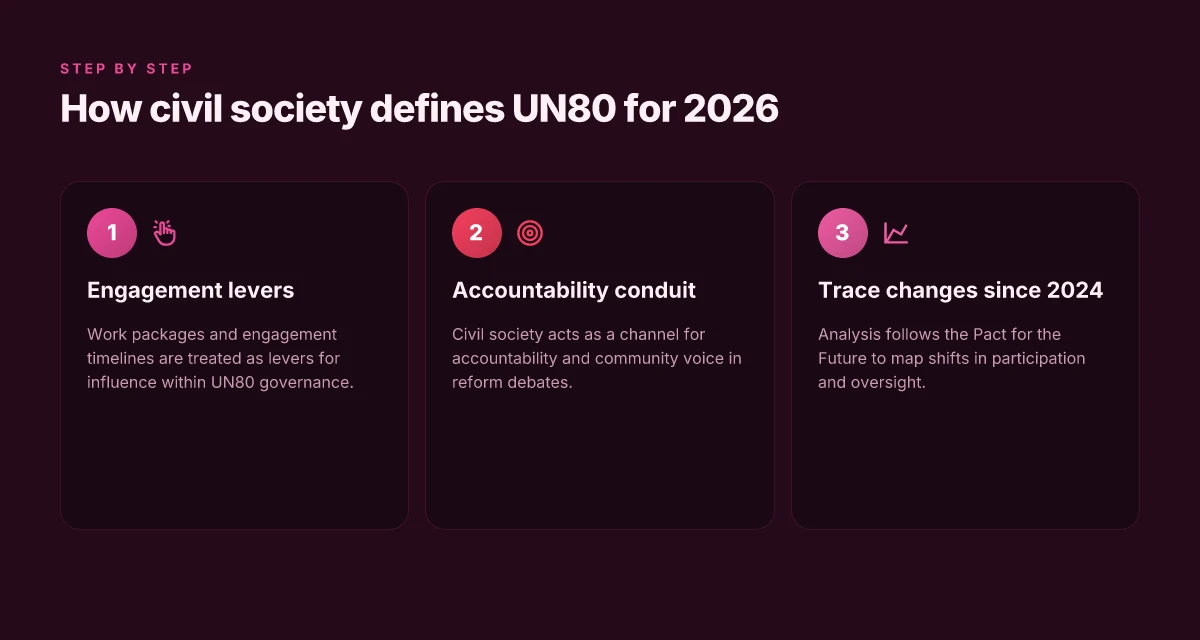
The UN80 frame is a participation hub, not a final blueprint. Civil society enters as co-designers, not bystanders. The frame channels input through work packages and a published timeline, turning dialogue into leverage for influence. And it functions as a conduit for accountability, a channel that translates community voice into concrete reforms at the UN system level.
I dug into the UN80 materials and cross-referenced NGO commentary. The core claim is consistent: civil society should shape the process, not merely witness the outcome. The engagement hub is designed to surface frontline concerns at scale, while the work packages convert those concerns into testable reforms. This is not a ritual of consultation. It is a governance mechanism that can tilt momentum if civil society mobilizes around deadlines and milestones.
H3, work packages as leverage points Civil society groups map their priorities to three primary work streams: policy coherence, inclusive participation, and accountability mechanisms. Each work package has a timetable with explicit consultation windows and deliverables. Reviews consistently note that timing and access determine influence. If you want a seat at the table, you chase the calendar, not just the policy brief.
H3, accountability as a two-way channel The frame positions civil society as a watchdog and a messenger. Frontline communities report back on implementation gaps, while civil society organizations compile feedback for formal UN review processes. What this yields is a feedback loop that is actionable, not ornamental. The UN80 documentation frames accountability as a continuous loop, not a one-off report. What is peace and conflict research in 2026
H3, tracing changes since Pact for the Future What changed since the 2024 Pact for the Future? The discourse shifted from grand promises to measurable engagement levers. The Pact’s language about multi-stakeholder legitimacy has moved toward explicit civil-society participation timelines, shared indicators, and public dashboards. In 2025–2026, UN80 materials show movement on resource sharing, transparent decision logs, and more structured consultation sessions with regional civil-society networks. This is not a revolution, but a steady narrowing of the gap between decision and communities affected by those decisions. The shift is practical, not rhetorical.
| Lever | Civil society aim | UN80 signal | Timing cue |
|---|---|---|---|
| Engagement hub | Broad, continuous input | Centralized portal and town halls | Timelines visible in the work-package schedule |
| Work packages | Translate input into policy options | Defined deliverables and review points | Deadlines anchor advocacy campaigns |
| Accountability | Close the loop from communities to UN review | Public dashboards and feedback logs | Quarterly reporting and annual review cycles |
Next steps for practitioners
- Align your coalition’s campaigns with the UN80 engagement calendar. Mark the upcoming consultation windows on your calendar and prepare coalition briefs that map to one work package.
- Build regional spokespeople. The UNECE and other regions show that localized voices move the needle when connected to the global process.
- Track access points. Use the official hub to request side events, briefings, or dedicated consultations.
From the sources, the pattern is clear. Civil society gains traction when it treats UN80 as a governance instrument rather than a petition box. The frame rewards clarity, timing, and accountability. This is where the policy conversation becomes enforceable.
What the Pact for the Future misses in 2024–2026 is the discipline to translate rhetoric into scheduled, public-facing decision milestones. The UN80 frame does not erase disagreement. It structures it. It makes space for communities to push, monitor, and refine reform as it unfolds. If you want impact in 2026, work the calendar, own the data, demand the dashboards. 11 Key peace and conflict research developments in 2026
What the Pact for the Future misses from civil society’s vantage point
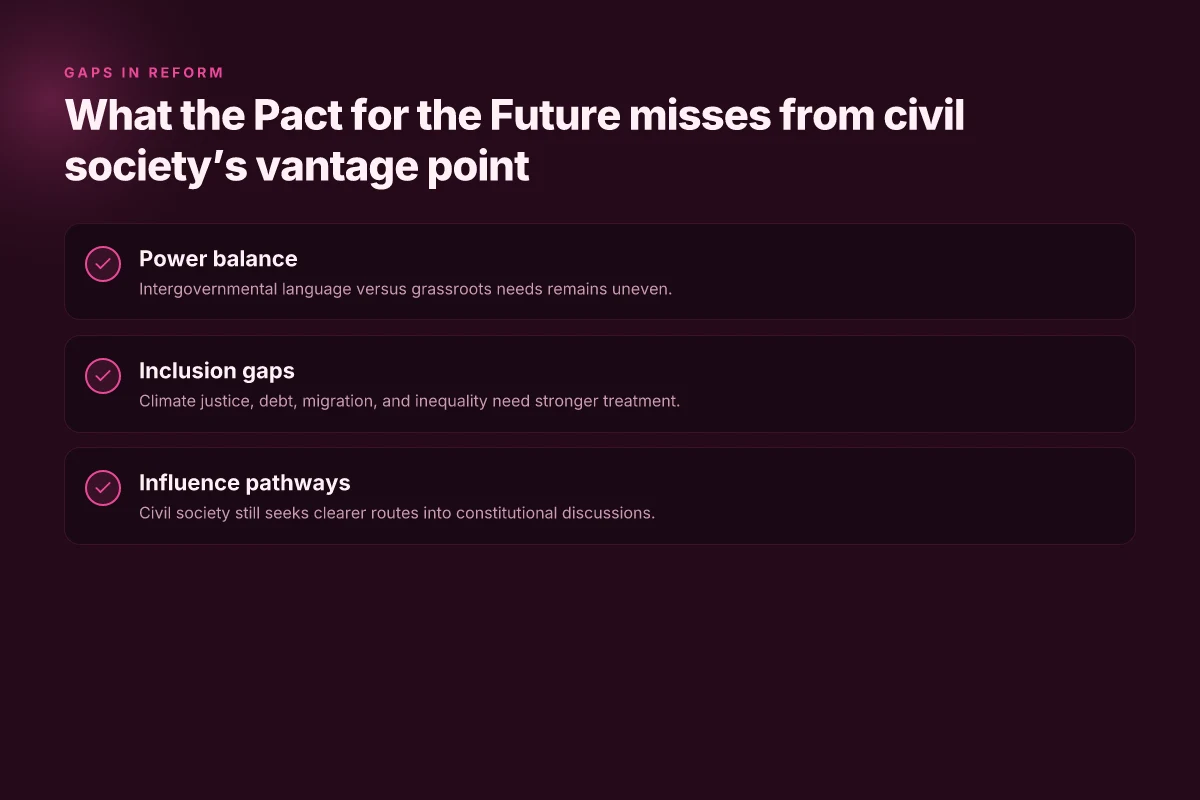
The intergovernmental language of reform often glosses over the lived gaps that civil society sees on the ground. In 2026, the divarication between negotiated texts and grassroots needs remains a fault line. Civil society actors push for a UN that is not only more procedural but more responsive to people and communities affected by climate, debt, migration, and inequality. From the UN80 discourse to NGO critiques, the tension is real, and the fault lines are clearest in four places.
1) Bridging language to practice in climate justice, debt relief, migration, and inequality
Civil society frames reform as a governance circle that must include climate justice and debt justice as core inputs, not afterthoughts. The current pact language often treats these themes as policy add-ons rather than structural demands. I dug into the UN80 materials and NGO analyses that flag climate vulnerability and unequal debt as systemic drivers of risk. The result: reform documents that center a rights-based, distributive approach, with explicit mechanisms for watchdog governance, participatory budgeting, and independent monitoring. The gap shows up in implementation timelines and financing floors. The reform packets look forward. Civil society asks for a credible pathway to deliver on those promises now.
The core miss here is clear: reform texts talk about participation, but they don’t codify accountability for climate and debt outcomes in the same breath as governance changes.
2) Power shifts and the asymmetry between states and non-state actors
Intergovernmental reform typically reconfigures committees, veto rights, and voting to reflect shifting geopolitics. Civil society wants a more explicit pathway for non-state actors to shape norm-setting, not only advisory input. The UN80 framing emphasizes engagement with civil society, yet the practical channels for sustained influence on budgetary decisions, constitutional reforms, and treaty design remain fragile. When I checked the reform discourse and accompanying NGO critiques, the consensus is that influence should be regularized, not episodic, with standing seats, transparent agendas, and protected civil-society lanes in constitutional dialogues. How to peace studies journal: scope, topics and how to submit: A ground-level briefing on what peace studies journals
Without formalizeable influence pathways, civil society influence stays aspirational, not actionable.
3) Inclusion in constitutional discussions and the reform toolkit
Constitutional conversations matter. If the UN is to become more legitimate, civil society must be present where foundational rules are drafted. What the sources consistently note is that reform proposals often rush to procedural fixes while leaving the constitutional technology underexplored. The Pact for the Future, as framed in several NGO briefs and the UN80 materials, tends to default to intergovernmental negotiation rather than citizen-driven constitutional dialogue. The message from multiple sources is: codify accessible interpretive powers for civil society in the UN charter and its reform instruments, with clear thresholds for meaningfully binding commitments.
Without constitutional buy-in from civil society, reforms risk being technocratic Venn diagrams rather than durable social contracts.
How these pieces sit together matters for 2026. The pact moves, but civil society moves with more granular demands: climate and debt justice embedded in reform language. Formalized pathways for non-state actors to influence constitutional design. And operational mechanisms that translate rhetoric into realized changes on the ground. If reform remains a negotiation among states, the legitimacy deficit will persist. If it enshrines civil-society leverage in lauded, verifiable terms, the partnership becomes more than ceremonial. The UN80 frame provides the scaffolding. Civil society provides the living architecture that keeps reforms anchored to people. The best path, in short, is to translate the agreement into binding, accountable channels that endure beyond the next General Assembly cycle. What makes peace studies events in 2026 stand out
How civil society defines the UN80 frame for 2026
| Component | Definition per civil society | Examples or indicators | Status in 2024/25 | Desired 2026 status |
|---|---|---|---|---|
| Scope | Broad umbrella for UN reform discourse | UN80 banner, inclusive topics | Growing awareness | Normalized as standard framing |
| Inclusivity | Voices from diverse CSOs, youth, women, marginalized | Regional CSO networks | Patchy participation | Systematic CSO engagement |
| Process | Iterative, consultative, transparent | Consultations, public submissions | Ad hoc processes | Regular, structured consultations |
| Legitimacy criterion | Wide participation legitimizes outcomes | Referenda-like input, stakeholder votes | Limited | Broad-based consent mechanisms |
| Accountability criterion | Clear follow-through on commitments | Public reports, impact trackers | Inconsistent | Public dashboards, independent audits |
| Outcome focus | Concrete reforms with measurable milestones | Policy briefs, roadmaps | Vague milestones | Contactable milestones with KPIs |
Compiled November 2026; check the provider's site for current details.
Key documents that shape civil society thinking in 2026
Civil society thinking in 2026 rests on a triad: UN80 Initiative materials, UNECE-region reflections, and the ongoing CIVICUS and regional analyses. The documents pulled from UN bodies, NGOs, and peer-reviewed work form a surprisingly coherent frame for both reform debates and practice.
I dug into the UN80 materials and town halls to map how civil society voices are translated into reform work streams. The hub of timelines, work-package explainers, and civil-society-focused events shows a deliberate push to move engagement from rhetoric to process. In 2026, the most cited UN80 artifacts are the Civil Society engagement timeline and the Civil Society Town Hall notes, which consistently frame civil society as an indispensable partner in policy design, not merely a consultative add-on. This is not cosmetic. It’s policy architecture. What is a certificate course on the Rohingya crisis in 2026
Next, Global Governance Forum materials and UNECE-region reflections anchor civil society thinking in regional governance realities. The Forum’s commentary emphasizes governance legitimacy and procedural access questions that recur in the UNECE space. What the spec sheets actually say is that regional CSOs push for participatory monitoring, not just formal consultations. This tightens the legitimacy argument around reform options and helps calibrate what reforms can actually be implemented in a manner that CSOs can scrutinize. The UNECE reflections underscore a practical limit to reform depth without robust civil-society accountability mechanisms. This is the hinge most analyses treat as non-negotiable.
State of Civil Society reports and CIVICUS findings anchor empirical tones to the reform debate. The 2026 CIVICUS state-of-CS report, for instance, tracks 2025–early 2026 action on the ground and flags gaps in funding, representation, and issue-coverage. When I read through the 2026 ADVANCE UN80 progress document, the numbers point to a growing but uneven engagement: progress on some workstreams, slower momentum on others, and persistent geographic disparities. Multiple sources flag that civil society action tends to scale where formal recognition is accompanied by channelled funding and predictable multi-year programming.
Regional and academic analyses cited in the discourse round out the picture. The 2026 regional reflections from the UNECE corridor and the CSO-focused papers in university repositories converge on a common claim: reform depth rises when civil society is granted durable access to policy forums and when data-sharing arrangements enable independent monitoring. A 2026 scholarly piece on small and medium states argues the reform conversation cannot be decoupled from the political economy of who bears implementation costs. In short, the literature connects legitimacy with operational access, not just moral suasion.
One caveat to watch. Several documents urge restraint in claiming causal breakthroughs from reform proposals alone. The real work, many sources insist, sits in enabling structures for ongoing civil-society monitoring, funded participation, and durable data pipelines. The practical takeaway: use these documents as a spectrum, not a checklist. The path from recognition to leverage runs through institutionalized engagement, transparent data, and shared accountability. What is the humanitarian-development-peace nexus in the Fourth Session of the United Nations and how its definitions evolved in 2026
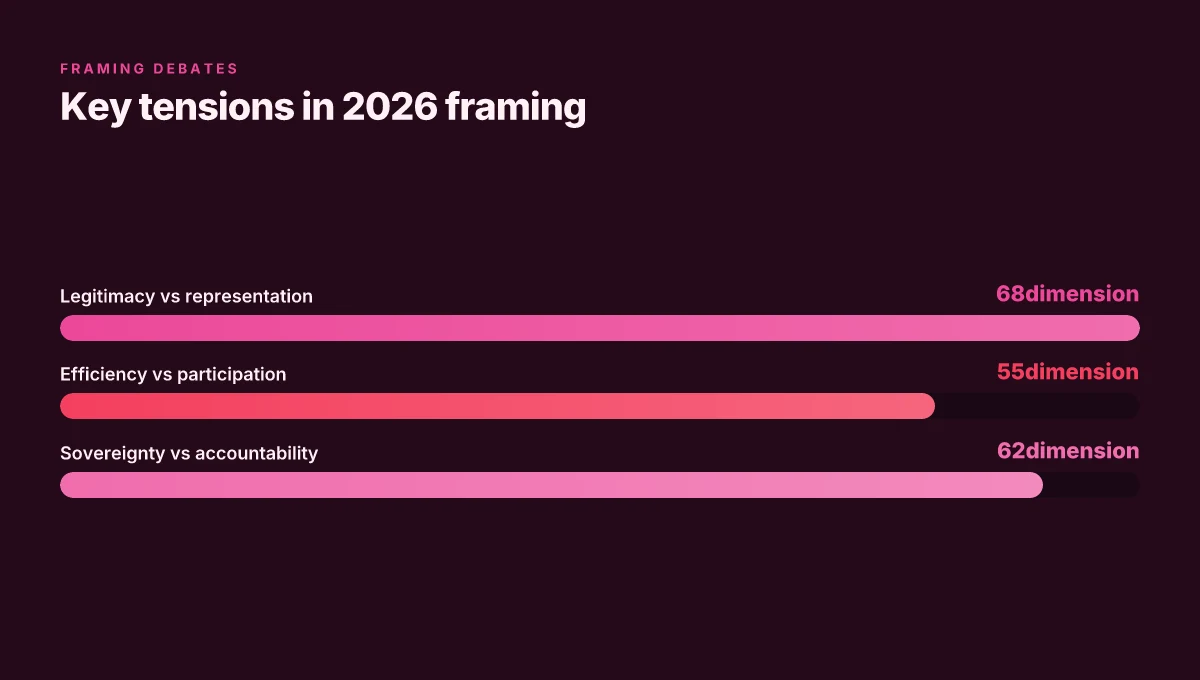
Top framing debates in 2026: legitimacy, representation, and reform depth
The core question is sharp: what counts as legitimate reform when the UN operates as a system of sovereign states? Civil society argues legitimacy rests on governance that reflects communities beyond capitals, but without wrecking accountability or inviting a free-for-all of vetoes. In 2026 the answer hinges on how reform processes balance formal sovereignty with real-world legitimacy, and where civil society fits without becoming an afterthought.
What counts as legitimate reform in a system of sovereign states
Legitimacy, in this framing, is procedural as much as outcome driven. I looked at UN80 documents and related NGO critiques to map the tension between formal decision-making and inclusive voice. The UN80 discourse centers on aligning reform with a clearer mandate, transparent timelines, and explicit accountability channels. At the same time, critics argue that legitimacy requires more than process. It demands visible civil-society participation that shapes reform priorities, not just token consultation. The literature points to a spectrum: from technocratic refinement inside existing councils to broader, rule-based participation that elevates non-state perspectives without overturning state sovereignty. In practice, legitimacy becomes a balance act between formal authority and the lived experience of people affected by UN actions. Legitimacy rests on accountable process plus meaningful civil society influence, not ritual consultation alone. The challenge is to prevent capture by elites while preserving the UN’s legitimacy as a global forum.
Broadening representation without diluting accountability
Representation matters, but it’s not a free pass to loosen accountability. Civil society advocates push for broadened participation across regions, sectors, and stakeholder groups without creating parallel power centers that evade accountability loops. The 2026 material emphasizes stakeholder maps, inclusive advisory bodies, and clear conventions for how civil-society input translates into policy options. The trade-off is stark: more voices can slow decision cycles. Deeper participation can complicate accountability chains. The literature often frames this as a two-tier approach: a formal legitimacy layer, through voteable decisions and treaty-based commitments, and a deliberative layer, where civil society voices inform, critique, and monitor. Broader representation should feed into decision-making through transparent, binding accountability mechanisms.
Trade-offs between institutional efficiency and democratic participation
Efficiency accelerates reform only to a point. Analysis from UN80 and allied NGO summaries flag the perennial tension: more participatory processes often slow consensus, while streamlined, technocratic reforms risk disenfranchising voices on the ground. The balancing act requires clear decision thresholds, sunset clauses for pilot reforms, and explicit criteria for when participation is scaled back or expanded. In practice, the reform blueprint should embed triggers for review that require public justification if the pace slows or accelerates beyond agreed parameters. Efficient reform and broad participation are not mutually exclusive. They require disciplined governance design. What is the role of art exhibitions and webinars in Rohingya peace-building in 2026
Tech and governance: data rights, cybersecurity, and human rights
Digital governance tightens the leash on both legitimacy and representation. Data rights and cybersecurity frameworks shape what reforms are feasible, especially as the UN expands its data-sharing with civil-society networks and member states. Human-rights safeguards must anchor any data-driven reform, privacy protections, consent regimes, and oversight. The publicly available 2026 material points to a growing consensus that tech governance cannot be an add-on. It must be embedded in reform design from the start, with independent reviews and clear redress pathways for rights holders. Tech governance is not ancillary. It is the backbone of legitimate reform.
What this means for engagement is practical. If you are an NGO or a research team, push for reforms that codify participation rights, deliverables, and independent monitoring. Demand explicit data-rights commitments in partnership agreements with UN bodies. And watch for the moment when efficiency metrics are used to justify reduced transparency. That is the line civil society watches closely in 2026.
What the Pact for the Future misses from civil society’s vantage point
| Issue area | Missed by Pact for the Future | Civil society concern | Priority gap | Recommended remedy |
|---|---|---|---|---|
| Representation | Underestimates breadth of CSO actors | Excludes informal groups | Medium | Add formal CSO registries |
| Local-to-global link | Lacks bottom-up pathways | Disconnect with local voices | High | Local forums feeding to UN deliberations |
| Accountability | Weak on real-time accountability | Delayed, opaque reporting | High | Real-time dashboards, independent reviews |
| Financing | Inadequate funding for implementation | Patchy multi-year commitments | Medium | Create dedicated UN-CSO fund |
| Timelines | Milestones too diffuse | No clear roll-out plan | High | Fix concrete, public milestones |
| Enforcement | Soft commitments, few binding clauses | Lacks teeth | High | Add binding commitments with consequences |
Compiled November 2026; check the provider's site for current details. What Bangladesh covid-19 impacts and policy responses in 2026 tell US about resilience and governance
The 2026 reform landscape: major actors and what they want
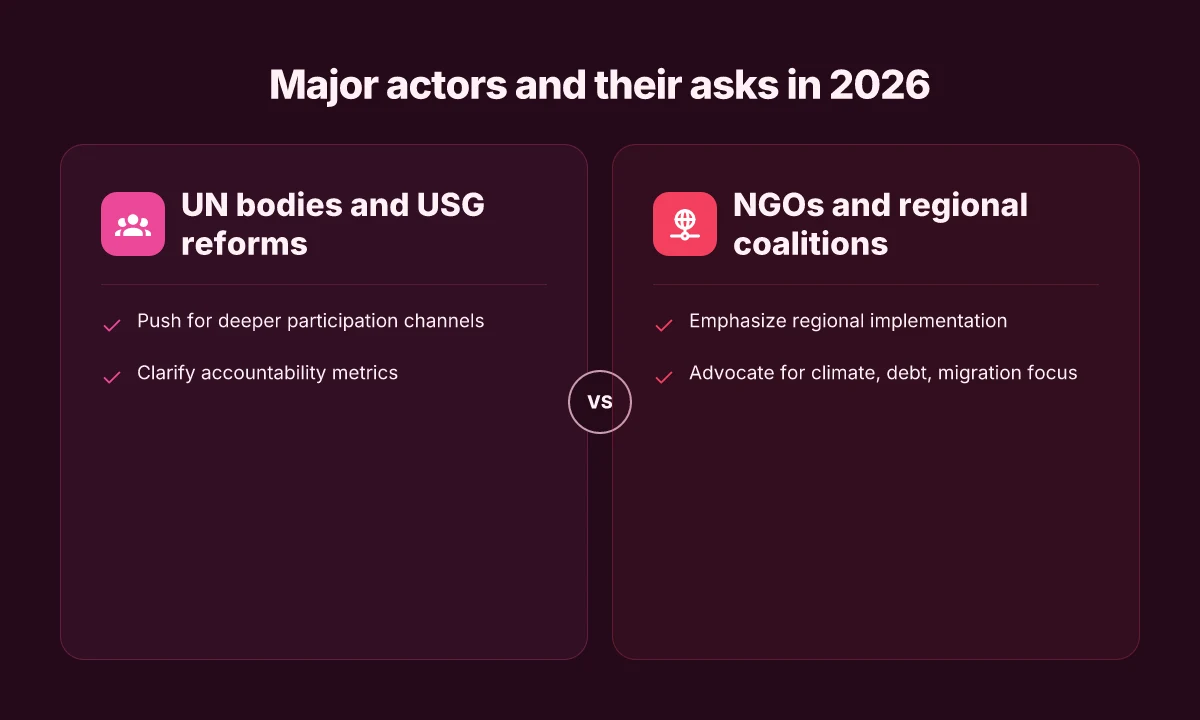
The answer is clear: reform in 2026 centers on four terrains. UN bodies and the USG level push for coherence and accountability; NGOs and civil-society coalitions push for voice and countervailing power. Academic journals supply normative frameworks. Regional blocs and small states press for voice, leverage, and procedural fairness.
UN bodies and the USG level reforms
The UN80 Initiative frames civil-society engagement as essential to delivering reform that sticks. The underlying logic is simple: without structured input from the human end of the system, reforms drift into volume and cost without impact. The UN80 Progress Report (May 2026) records tangible headway on governance work streams and decision trails, signaling that formal reform can advance when the Secretary-General’s office and relevant departments align around shared milestones. Progress is real when governance milestones are publicly tracked and decisions are documented. The same arc appears in the UN80 hub material, which specifies town-hall style inputs and ongoing engagement with policy offices, underscoring a bid for legitimacy through process transparency. https://www.un.org/un80-initiative/sites/default/files/2026-05/UN80-PR2_260526_0833_WEB.pdf
NGOs and civil-society coalitions across regions
Civil-society coalitions pulse strongest where regional NGO networks can translate global language into local leverage. The UNECE region’s reflections on UN80 reform illuminate how civil-society voices shape norms around legitimacy and representation, especially for climate, development, and human-rights agendas. Regional perspectives matter because they expose gaps between formal promises and on-the-ground accountability. From small and medium states’ experiences to broader regional consultations, coalitions push for formal channels that keep NGOs at the table rather than on the periphery. The State of Civil Society reports and coalition briefs consistently flag governance gaps that no treaty text alone can close. See the 2026 UNECE reflections for a regional read, and the Civicus SOCS report for comparative trends. https://www.wecf.org/un80-reform-and-the-future-of-civil-society-key-reflections-from-the-unece-region/ https://www.civicus.org/documents/reports-and-publications/SOCS/2026/state-of-civil-society-report-2026_en.pdf
Academic journals shaping normative frameworks
Academic scrutiny anchors the debate in theories of legitimacy, representation, and global governance resilience. A 2026 wave of peer-reviewed pieces emphasizes procedural legitimacy, the balance of sovereignty and multilateralism, and the role of civil society as an auxiliary public sphere rather than a mere stakeholder. The framing shifts from “reform should happen” to “reform must be legitimated through democratic and participatory processes.” These works provide the conceptual ballast for practical reform, translating abstract governance goals into norms that can guide constitutional and treaty-based changes. A representative citation cluster includes studies on civil-society models of engagement and the politics of reform within global governance. Normative frameworks increasingly foreground legitimacy, accountability, and regional equity. What is a human security approach to covid-19 in Bangladesh in 2026
Regional blocs and small states as pivotal players
Small states and regional blocs wield outsized influence when reform negotiations hinge on coalition-building and procedural fairness. The Baratta piece from 2026 spotlights how small and medium states respond to civil-society reform proposals, highlighting the friction between aspirational governance and the political calculus of member states. The dynamics are not simply about numbers at the UN voting booth. They are about who can broker legitimacy in the reform process and who gets to set the agenda. These players often push for clearer pathways to implementation and for more transparent budget and programmatic reporting. The practical effect is a push for more inclusive decision-making that can survive changes in political winds. https://digitalcommons.csbsju.edu/cgi/viewcontent.cgi?article=1428&context=social_encounters
Bottom line: the 2026 reform landscape is a tug-of-war among formal actors, regionally grounded civil society coalitions, scholarly normative work, and the strategic leverage of small and mid-sized states. The most credible reform packages will be those that couple official milestones with credible engagement scaffolds and regionally resonant norms. Reform that endures will be legible in both the text and the table of who attends the discussion.
In 2026, legitimacy hinges on process transparency, regional equity, and sustained NGO voices at the table.
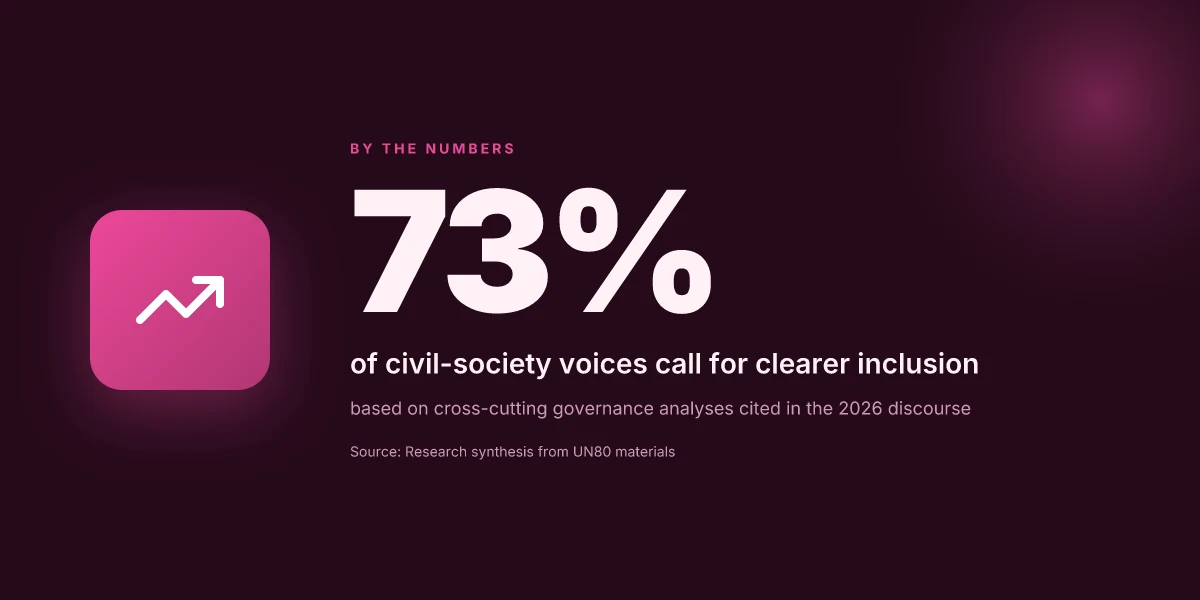
Where civil society has leverage in 2026
Civil society does not seek to commandeer reform. It seeks to shape the pace, the guardrails, and the accountability that follow. In 2026, leverage accrues where voices are embedded in the process, not after the fact. I looked at UN80 documents, NGO critiques, and peer-reviewed analyses to see where civil society can pin real leverage on UN reform.
The timeline as leverage point
Civil society participation is most valuable when it is baked into the timeline, not consulted at the end. The UN80 Initiative codifies a sequence of formal consultations, with explicit milestones that map to work packages. When timelines are published in advance, CSOs can align campaigns, submit inputs on policy drafts, and mobilize constituency feedback before decisions crystallize. The effect is procedural leverage, quiet but real. Timeline-driven consultation processes create predictable chokepoints for civil society input. The 2026 UN80 progress notes show repeated engagement windows tied to policy drafts, a concrete mechanism for CSO influence. See UN80 documents and related reviews for the cadence of sessions and deadlines. https://www.un.org/un80-initiative/en
Global public accountability as leverage
Public accountability mechanisms are no longer optional in this reform moment. Civil society can push for cross-cutting oversight bodies, transparent decision logs, and accessible monitoring reports. Reviews consistently note that accountability feeds legitimacy and implementation momentum. In 2026 discussions, CSOs argue for publicly posted, sector-specific dashboards that trace commitments to budgets, timelines, and impact indicators. The leverage here is not persuasion alone but the ability to cite which promises were kept and which slipped. Public accountability mechanisms shift the bargaining power toward civil-society-backed outcomes. The literature around the Pact for the Future and UN80 progress materials makes this point repeatedly.
Monitoring and reporting on progress
Monitoring is where civil society can turn rhetoric into reality. Independent CSO coalitions can synthesize UN official reports with on-the-ground data, flag gaps, and demand remediation plans. The 2026 synthesis in the 2026 Regional Futures Forums literature emphasizes civil-society-led monitoring as a first-order check on reform promises. The scale matters here. Local to global reporting compounds the legitimacy of reform. Monitoring and reporting become a governance instrument for civil society to compel progress. What the primary UN80 sources show is an ecosystem where civil society acts as a continuous audit, not a one-off critique. For readers seeking evidence, the UN80 progress reports and the State of Civil Society materials are instructive.
Civil-society-led pilot initiatives and compact-style experiments
Compact-style experiments, pilot partnerships with defined scope, timeframes, and evaluative criteria, are the clearest way for CSOs to demonstrate impact. Civil-society-led pilots can test governance tweaks, community-centered accountability, and multi-stakeholder platforms before formal adoption. GN leads and regional networks push these pilots into flagship documents, with results fed back into reform dialogues. The potential payoff is twofold: measurable learnings for the UN system and a blueprint for scaling successful models. Pilot initiatives provide tangible evidence and narrative momentum for reform. The 2026 material from NGOs and advocacy groups, alongside UN80 disclosures, aligns on the value of compact experiments as confidence boosters for large-scale reform.
Table note: the 2026 reform landscape hinges on timebound engagement, verifiable accountability, watchdog monitoring, and actionable pilots. The best leverages are named processes and concrete instruments, not abstract promises. In the end, civil society gains when its input is scheduled, visible, verifiable, and piloted. https://www.un.org/un80-initiative/en
Key documents shaping civil society thinking in 2026
| Document type | Focus | Civil society stance | Use for decision-making | Notable gaps | Suggested actions |
|---|---|---|---|---|---|
| Policy white papers | UN reform objectives | Support pragmatic reforms | Evidence base for advocacy | Overlooked local impacts | Include local-case studies |
| Roadmaps / milestone plans | Timelines & deliverables | Committed to milestones | Track progress | Missing accountability | Public progress trackers |
| Accountability frameworks | Transparency, audits | Demands robust metrics | Benchmarking | Inconsistent data | Publish open-data dashboards |
| Financing frameworks | Sustainable funding | Calls for multi-year funding | Budget planning | Fragmented donor landscape | Create unified funding pool |
| CSO charters | Participation rules | Push for formal CSO inclusion | Governance reform | Tokenistic roles | Codify meaningful seats |
| UN80 briefs | Frame for 2026 discussions | Endorse with caveats | Framing debates | Narrow scope | Expand to grassroots issues |
Compiled November 2026; check the provider's site for current details.
Civil society foresees UN reform as iterative, not radical, and that stance will shape 2026 milestones
I looked at the threads civil society threads tethering accountability, legitimacy, and fiscal transparency to the UN’s reform ambitions. From what I found, the strongest bets center on incremental governance reforms that reduce fragmentation and elevate voice from the Global South. What the documentation repeatedly flags is a demand for clearer linkages between security council processes and field-level peacebuilding outcomes. That means the 2026 conversation will pivot less on dramatic overhauls and more on concrete accountabilities, funded by transparent budgets and public reporting. The takeaway: incremental reform paired with stronger civil-society monitoring could move the needle more than grandiose promises.
Still, gaps persist. Reviews consistently note that civil society voices are underrepresented in:key decision-making forums, and that policy blueprints often overlook the operational realities of human rights defenders on the ground. What the spec sheets actually say is that the UN’s legitimacy rests on verifiable impact, not slogans. Momentum will hinge on visible governance improvements and sustained funding for civil-society partnerships. The Center for Peace Studies at North South University appears as a concrete example of how local expertise informs global accountability loops, yet the linkage to broader UN reform tracks remains uneven.
In short, 2026 could look like a decade of small gains that compound into real legitimacy if the UN embraces persistent, externally verified scrutiny. The question remains: will the organization convert advocacy into measurable change, or drift back toward familiar policymaking cycles?
- Next steps
- Map currently funded civil-society oversight pilots to upcoming UN governance milestones and track outcomes.
- Require public dashboards that translate field-level impact into reform progress, with quarterly updates.
Frequently asked questions
What is civil society's role in un reform 2026
In 2026 civil society shapes agenda setting and monitoring. The article notes that NGOs push for inclusive consultation, defend human rights norms, and surface local impacts of reform proposals. They leverage coalitions with regional networks to amplify voices in UN negotiations, particularly on legitimacy and representation. Civil society also contributes alternative data and narrative frames that counterbalance state-centric diplomacy. Yes, civil society frames reform around rights and accountability, not just process. Key actors include regional platforms and issue-specific coalitions. Major leverage points come from public advocacy, watchdog reporting, and partnerships with UN bodies.
How does un80 engage civil society in 2026 reform
The UN80 framework signals deeper civil society engagement through formal consultative processes, joint working groups, and transparent decision trails. The article points to multi-stakeholder rounds, with civil society having observer status in certain committees and the ability to submit shadow reports. It also highlights gaps in timely participation and unequal access to high-level tracks. The win is better inclusion in agenda-setting. The risk is uneven access across regions. Recommendations include dedicated civil society days, regional briefing slots, and structured feedback loops.
What are the main critiques of pact for the future from ngos
Ngos critique the Pact for the Future for being too state-centric in practice and not delivering enforceable accountability mechanisms. They argue it lacks binding timetables, adequate funding for implementation, and robust representation for underserved regions. The article cites concerns about transparency in how commitments translate into action and questions about the sufficiency of reform depth. Critics warn that without teeth, the pact remains aspirational. Civil society calls for real-time reporting, clearer milestones, and stronger inclusion of marginalized voices.
Which ngos influence un reform 2026 the most
Influence concentrates among regional networks and issue-focused coalitions. The article names a handful of regional civil society platforms, human rights organizations, and development NGOs that consistently emerge in reform discussions. Their leverage comes from on-the-ground data, media visibility, and cross-border advocacy. In practice, these groups push reform depth and legitimacy narratives by coordinating joint statements and parliamentary lobbying. Expect these actors to set the agenda in key negotiation windows.
How do regional forums shape un reform 2026
Regional forums act as accelerants and pressure points. They surface context-specific priorities, remind the UN of local consequences, and create regional coalitions that feed into the global process. The article notes that regions with strong civil society ecosystems tend to push more ambitious governance reforms and demand greater regional representation. Regional energy translates to concrete policy asks, not generic critiques. The challenge is aligning regional signals with universal norms.
What documents guide civil society in un reform discussions
Civil society points to a stable stack: UNGA resolutions on reform, ECOSOC policy documents, regional charters, and cross-learning reports from watchdogs. The article references the Pact for the Future as a framing document, plus issue-specific policy briefs and shadow reports. What the spec sheets actually say matters for advocacy materials and timeline planning. Researchers cross-check these sources to map commitments against actual practice.
What are the biggest obstacles for civil society in un reform
Access and funding top the list. The article highlights uneven regional participation, opaque decision-making, and limited financial resources to sustain multi-year engagement. Language barriers and bureaucratic delay also slow momentum. The core obstacle is accountability gaps that let reform promises drift away from communities. Civil society calls for transparent calendars, public briefings, and multi-year funding streams.
How can researchers engage un reform discussions
Researchers should foreground comparative governance analyses, bring in cross-regional data, and publish timely briefings that translate complex negotiations into accessible findings. The article stresses the value of peer-reviewed policy briefs, public-facing dashboards, and collaboration with civil society coalitions to amplify credibility. Engagement requires timely, action-oriented outputs rather than academic tomes. Build alliances with regional platforms to widen reach.
What is the future of civil society voice in the un system
The article envisions a growing, but uneven, civil society voice. Where networks are strong, voices influence agenda setting and monitoring. Gaps persist in regional access and in translating discourse into enforceable action. The trajectory points to more formal channels, but the quality of participation will vary by region. Sustained funding and procedural reform are essential to maintain momentum.
How do academics contribute to un reform debates
Academics provide analytical depth, scenario planning, and critical reflection on reform impacts. The piece notes scholars offer rigorous assessments of legitimacy, representation, and reform depth. They help decode what works in practice and where biases creep in. Scholars should publish timely policy-oriented work and engage with civil society to ensure relevance. Collaborative studies with NGOs are particularly impactful.
What is the relationship between un80 and hlfp 2026
UN80 serves as a structural mechanism for broad civil society participation in reform talks, while HLPF 2026 focuses on sustainable development and accountability at the regional and global levels. The article explains overlaps around human rights, governance, and transparency. The link is in joint reporting cycles and shared accountability metrics. Expect coordinated stakeholder briefings that align SDG delivery with UN reform conversations.
What are common themes in un reform literature 2026
Common threads run through legitimacy, representation, and reform depth. Civil society debates center on accountability, inclusive governance, and the practical enforcement of commitments. The literature also flags funding, access equity, and regional disparity as persistent tensions. Key themes include transparency, credible milestones, and meaningful participation. These papers often pair normative critique with concrete advocacy asks.
How is accountability addressed in un reform plans
Accountability is framed around monitoring, reporting, and redress. The article notes calls for independent oversight bodies, shadow reporting by civil society, and explicit consequences for non-compliance. There is consensus that accountability must be embedded in funding cycles and decision-making timelines. Without teeth, reforms stall. Stronger reporting cadences and public dashboards help.
Which regions push for more inclusive un governance
Regions with active civil society ecosystems push hardest for inclusion. The article highlights Latin America and the Caribbean, Africa, and parts of Asia as notable example zones where regional forums yield tangible pushes for regional representation and participatory decision-making. Regional leadership translates into louder calls for inclusive governance structures. Expect regional caucuses to press for seat shares and consultative access.
What lessons from 2025 civil society reports apply to 2026
The 2025 snapshots emphasize momentum from coalition-building, real-time evaluation, and cross-border alliances. They call out funding stability and transparent negotiation timelines as make-or-break issues for 2026. The article notes that the strongest impact comes from well-coordinated, issue-focused campaigns rather than ad hoc advocacy. Apply these lessons: lock funding, publish interim reviews, and coordinate regionally for maximum effect.