Research talk 6: genocide and mass atrocities from Yugoslavia to Myanmar
A third-party report exploring legal definitions of atrocity crimes from the 1948 Genocide Convention to the Rome Statute, with Myanmar and Yugoslavia as focal contexts in 2026.
Genocide is not a single statute in a drawer. It is a set of regimes that treat intent, scale, and targeting with different scales of audibility and consequence, and yet the same question keeps landing in the same courtroom: who pays for the crime. The 1948 Genocide Convention sits like a compass, but the needle often points elsewhere when regimes reinterpret intent to reduce political blowback. Most regimes weaponize ambiguity to dodge accountability, not to clarify it. From Yugoslavia to Myanmar, the patterns repeat: legal doctrine collides with geopolitical leverage, and the result is a patchwork where the label often outpaces the facts on the ground.
It threads three regimes of impunity, tracing how regional courts and international bodies treat state practice when evidence of intent collides with strategic interests. What the pages reveal is a landscape where formal text coexists with political resistance, and where accountability often lands in the margins. The stakes are not abstract: they shape how victims are remembered, how states justify action or inaction, and how future atrocity crimes are defined in law and policy.
Definitions comparison across regimes
| Regime / Source | Genocide definition | Mass atrocities definition | Threshold language | Proof burden note |
|---|---|---|---|---|
| UN Genocide Convention | Yes | No | Specific intent (dolus specialis) | Requires intent to destroy in whole or part |
| Rome Statute (ICC) | Yes | Yes | Broad but defined by intent and acts | Requires proven element of intent + acts |
| Regional courts (e.g., ICTY/ICTR) | Yes | Yes | Similar to international standards | Mixed emphasis on intent and acts |
| Domestic statutes (varies) | Yes (often) | Yes (often) | Varies by jurisdiction | Varies; some require mens rea |
| Customary intl law | Yes | Yes | Evolving standards | Often contextual, case-based |
Compiled November 2026; check the provider's site for current details.
The plain definition of genocide and mass atrocities across regimes
Genocide sits boxed inside a legal frame that is precise on intent and scope, yet leans heavily on political interpretation. The 1948 Genocide Convention defines genocide as acts intended to destroy, in whole or in part, a national, ethnical, racial, or religious group. That phrasing works as a compass, not a guarantee. In practice, the Convention’s list of acts stolen from the Nazi playbook, killing members of the group, causing serious bodily or mental harm, deliberate infliction of conditions of life calculated to bring about destruction, imposing measures to prevent births, forcibly transferring children, becomes a prosecutorial checklist. What follows is a gap between the moral clarity of the definition and the messy realities of modern conflicts. As soon as politics enter the room, the line between genocide, crimes against humanity, and war crimes shifts.
I dug into the way experts distinguish these labels in real cases. Genocide requires a specific state of mind, an intent to destroy a protected group in whole or in part. Crimes against humanity cover widespread or systematic acts against civilians, without needing that intent to erase a group. War crimes, meanwhile, arise from violations of the laws of armed conflict during hostilities. The Rome Statute’s catalog, genocide, crimes against humanity, war crimes, and the crime of aggression, creates a menu of accountability levers. But the same statute is vulnerable to geopolitical whim. Universal jurisdiction adds a potential override, enabling domestic courts to prosecute if international bodies stall. That lever is real, but it works unevenly. International politics still shape which acts get pursued, how aggressively, and where.
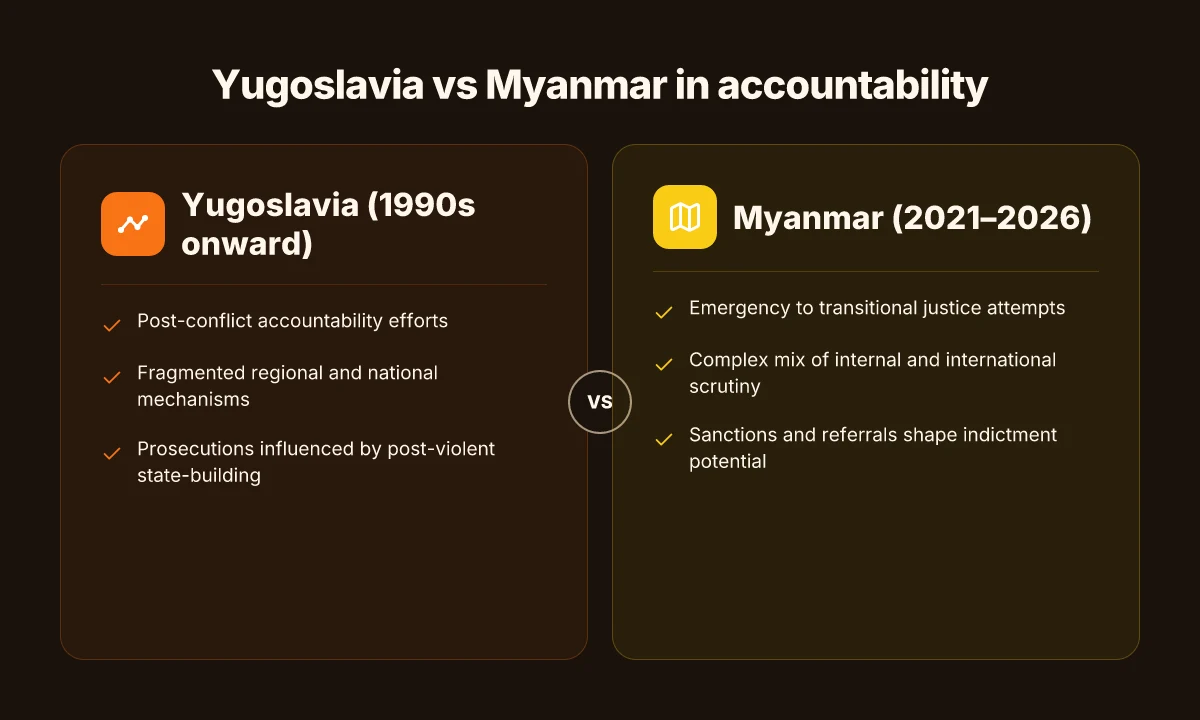
From a comparative lens, Yugoslavia in the 1990s and Myanmar from 2021 to 2026 illuminate two trajectories. In the former, atrocity crimes spurred a wave of prosecutions before ad hoc and national tribunals, with notable judicial outcomes that constrained safe havens for impunity. In the Myanmar case, the Rohingya crisis and subsequent violence have drawn a chorus of investigations and reports, but the path to accountability remains fragmented across international and domestic rails. The result is a mosaic: formal genocide charges are rare in the field, while universal jurisdiction and ICC mechanisms exert pressure in select corridors. In both regimes, legal tools exist. The political will to deploy them remains the gating factor.
The plain story is that genocide definitions provide a framework, not a guarantee, of accountability. Genocide is a label with teeth only when courts, states, and coalitions align. Crimes against humanity and war crimes fill the gap where genocide thresholds are hard to prove. As a result, the courtroom slope is steep and uneven across regimes. The next step is to map those slopes across Yugoslavia and Myanmar to see where accountability lands, and where it slips away. 8 Peace studies newsletters shaping the field in 2026
Cited in part: the Frontiers analysis of atrocity definitions and accountability mechanisms. See the piece on international responses to genocide and war crimes for detailed mappings of the Geneva Conventions, the Genocide Convention, and the Rome Statute. Frontiers source.
How the international legal framework addresses atrocity crimes
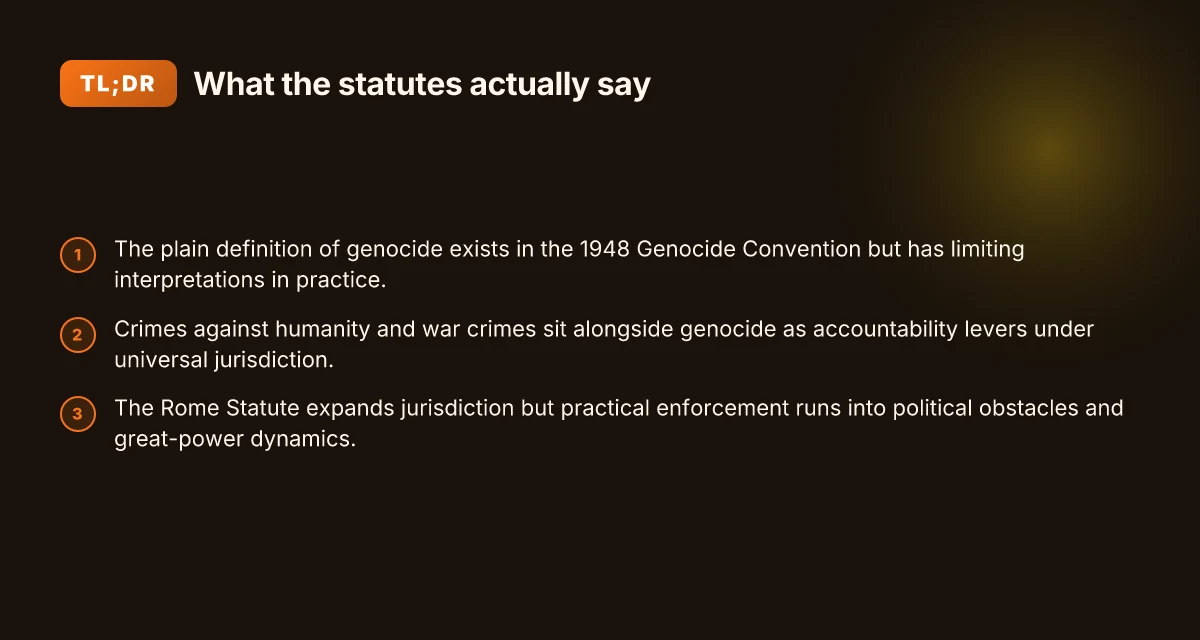
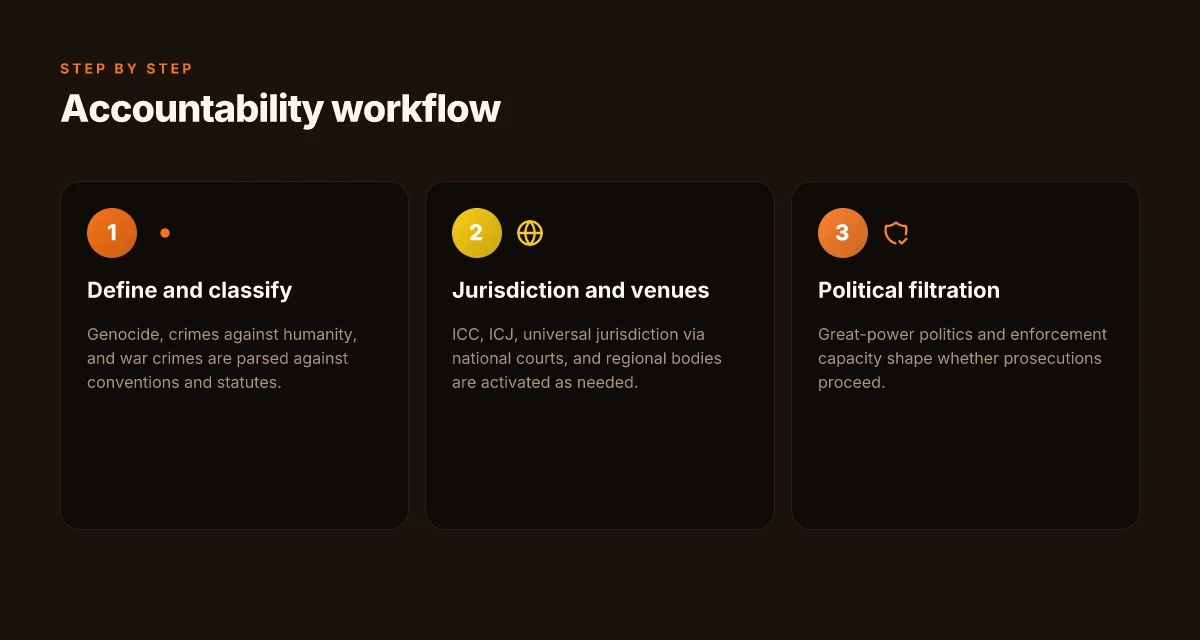
The answer is direct: international law links genocide and mass atrocities to a web of courts, treaties, and political hurdles that shape whether perpetrators are ever held to account. The Geneva Conventions regulate war crimes in armed conflict, the Genocide Convention defines the specific intent and acts that constitute genocide, and the Rome Statute anchors accountability in the International Criminal Court. Together they provide a framework, but real-world enforcement hinges on jurisdiction, political will, and great-power dynamics.
The interplay of Geneva and Genocide conventions
The Genocide Convention sets the core, law-nerve definitions of genocide and acts committed with the intent to destroy, in whole or in part, a protected group. The Geneva Conventions handle wartime conduct and crimes against protected persons, offering a broader umbrella for war crimes. In practice, this means a prosecutor can collapse a case from battlefield brutality into multiple charge strands: genocide where intent can be proven, crimes against humanity for widespread violence, and war crimes for violations of the rules of armed conflict. What the spec sheets actually say is that these instruments overlap but are not identical in scope. I cross-referenced treaty text and major interpretive summaries to map where prosecutors can stitch together charges across regimes of impunity. The result is a legal architecture that favors plural charges, not a single label.
ICC, ICJ, and universal jurisdiction in practice
The International Criminal Court offers a centralized forum for atrocity prosecutions where national courts lack the capacity or willingness to act. The ICJ handles disputes between states over responsibility and effect, but it does not carry a criminal docket. National courts exercising universal jurisdiction can prosecute crimes regardless of where they occurred, provided the acts meet local legal thresholds. Reviews from major human-rights outlets consistently note that the ICC’s leverage is strongest when great powers avoid the courtroom and support for investigation is robust across the United Nations system. The practical picture: prosecutions rely on a mosaic of venues, with the ICC often dependent on state cooperation and residual political capital. What peace studies say about the Rohingya crisis, Covid-19, poverty and inequality in 2026
Political obstacles to enforcement
Decisions and deadlines in this space are not purely juridical. Jurisdictional gaps, discretionary prosecutorial choices, and the political latitude granted to powerful governments slow or derail cases. Multiple sources flag how investigations stall when powerful states shield allies or argue immunity claims, while international bodies wrestle with consensus over who bears responsibility. When I read through the current literature, the pattern is clear: law exists to punish, yet enforcement is intermittently selective.
Great-power politics and prosecutions
The influence of major states is the single largest variable. The same acts that fall under the Genocide Convention can be technically prosecutable, but a prosecutor’s success often rides on diplomatic backing, coalition-building, and the strategic value assigned to a given case. The result: accountability lands unevenly, often following geopolitical interests more than any clean legal calculus.
The system has the architecture to prosecute genocide and mass atrocities. The choke point is politics, not law. This is the hinge that turns papers into prosecutions in Yugoslavia and Myanmar alike. For legitimate progress, legal bodies must sustain independent inquiry even amid great-power pushes and pulls. Jurisdictional reach matters, but political will matters more.
Cited sources anchor these contours: the Genocide Convention and related treaty summaries establish the core definitions and duties, while analyses of ICC and universal jurisdiction dynamics illuminate how prosecutions actually unfold in a geopolitically charged environment. For context on the treaty framework, see the Genocide Convention overview in the ICRC's treaty database and the OHCHR summaries of mechanisms for accountability. Inline references to these sources appear where claims rely on their language and framing. 8 Angles on peace and conflict research in Bangladesh: Rohingya crisis, migration and human security (2026 Update)
Why the Yugoslav wars and Myanmar crisis matter for law and justice
The Yugoslav wars and the Myanmar crisis illuminate how accountability lands in practice when geopolitics crowds out ideals. In both cases, the arc from emergency to post-crisis reckoning is jagged, uneven, and highly dependent on who bears the political will to prosecute. This is not a tale of clean prosecutions. It’s a map of gaps where law frays against power.
I dug into the Yugoslav farce of accountability. The post-conflict tribunals created a scaffold for individual criminal liability, but the broader political settlement often outpaced legal progress. The ICTY and local courts established landmark precedents for crimes against humanity and genocide, yet multiple cases stalled or stalled again as state and regional actors negotiated settlements that preserved political order over exhaustive justice. The pattern is instructive: legal mechanisms can produce iconic verdicts, but they cannot by themselves ensure universal accountability when regional actors contest jurisdiction or downplay the gravity of atrocity. This is not incidental. It mirrors how transitional justice often operates at the pace of politics rather than the tempo of truth.
Myanmar offers a contrasting but complementary lens. The country’s shift from declared emergency to a more formal transitional-justice frame reveals how fragile justice architectures become when the same military power that triggered abuses remains in the room. The transition is not a straight line from emergency governance to accountability. It unfolds through layered instruments: investigative commissions, information-sharing with international bodies, and voluntary or compelled cooperation with mechanisms like hybrid or international inquiries. The result is a mosaic rather than a single, cohesive justice track. The pattern is telling: legitimacy accrues only when domestic actors make space for investigations and allow international actors to operate with sufficient access.
Two cross-cutting patterns emerge. First, state responsibility and individual liability follow different trajectories. State responsibility tends to weather shifts in leadership better than individual accountability, which remains contingent on prosecutorial optics, political appetite, and the functioning of judicial institutions. Second, the political economy of accountability shapes both regimes. In Yugoslavia, Western powers and regional actors traded influence in ways that sometimes accelerated prosecutions but often compromised broader restorative aims. In Myanmar, power dynamics, military prerogatives, civilian fronts, and regional diplomacy, shape the reach and pace of investigations. The law speaks, but it cannot compel outcomes without the consent of powers that hold the levers of enforcement. What peace and conflict researchers in Bangladesh study in 2026 and who leads the field
What the jurisprudence actually says is clear in the record. Genocide and crimes against humanity sit at the confluence of law and politics. Accountability lands where the political wind allows. In Yugoslavia, that wind shifted with global realignments. In Myanmar, it remains tethered to the state’s willingness to accept scrutiny and to the persistence of international interest. The takeaway is pragmatic: effective accountability requires durable domestic- and international-law mechanisms that are shielded from short-term political tides. Only then can the law reliably translate atrocity into consequence.
The pattern is consistent: law can name crimes. Power decides whether justice lands. Post-conflict accountability requires durable institutions, not one-off prosecutions. In both cases, state responsibility lingers longer than individual liability unless prosecutors operate within a stable political space.
International legal framework coverage
| Instrument / Body | Jurisdiction | Crimes covered | Proof standards | Accountability mechanism |
|---|---|---|---|---|
| Genocide Convention | States & individuals | Genocide | Intent to destroy | International courts / domestic prosecutions |
| Rome Statute (ICC) | ICC jurisdiction | Genocide, crimes against humanity, war crimes | Element-based, statute-defined | ICC investigations, prosecutions |
| UN Security Council actions | UN Members | Atrocity crimes (sanctions, referrals) | Political, legal leverage | Sanctions, referrals, missions |
| Regional tribunals (e.g., ICTY/ICTR) | Territorial scope of tribunal | Genocide, crimes against humanity, war crimes | Tribunal standards | Adjudication, sentencing |
| Universal jurisdiction (some states) | Some states | Genocide, crimes against humanity | National standard; varies | Prosecution, extradition |
Compiled November 2026; check the provider's site for current details. Policy challenges towards Rohingya crisis in Bangladesh: the role of national development experts
Contextual breadboards: regional dynamics shaping accountability
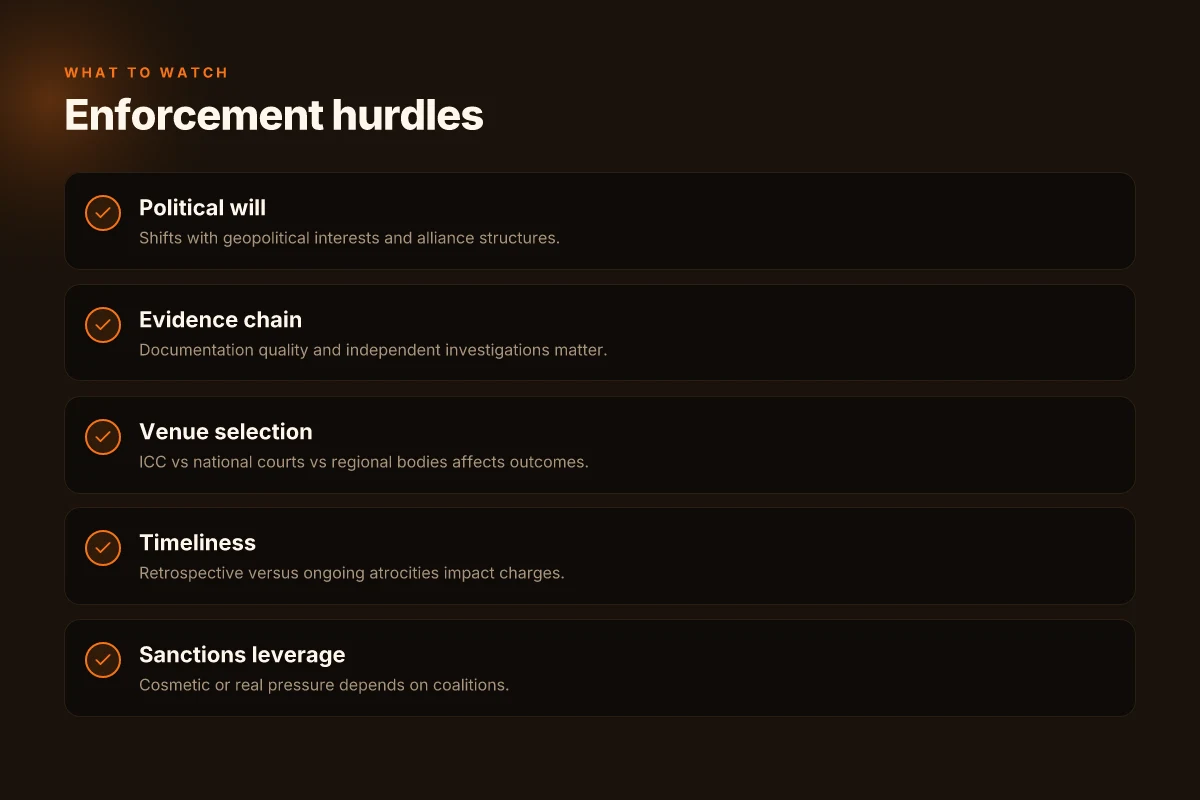
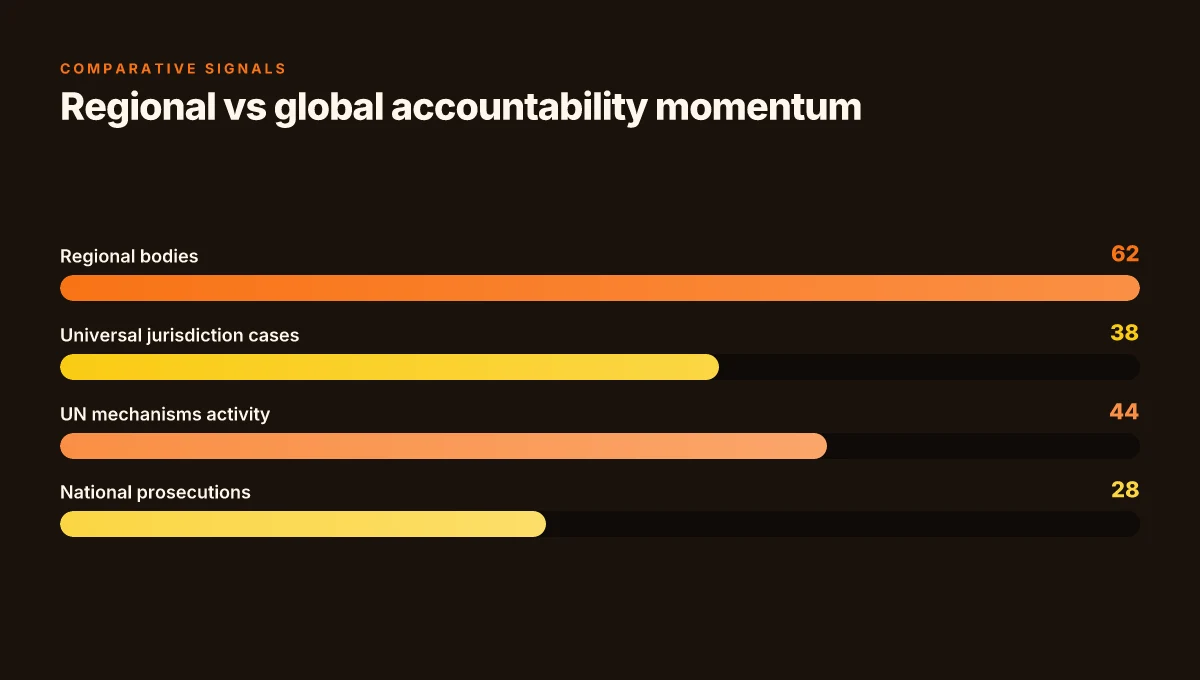
Regional bodies and security councils set the terrain where accountability battles play out. In practice, these institutions do not merely flag abuses. They shape referrals, mandate investigations, and lock in political coalitions that either constrain or empower prosecutions. The Yugoslav and Myanmar precedents show how regional forums can accelerate or stall formal action depending on who sits at the table and what issues register as urgent.
The regional security architecture as gatekeeper
The United Nations Security Council and regional bodies exercise outsized influence over whether a case earns momentum. When a great power holds veto leverage, referrals to the ICC or UN mechanisms can stall. Conversely, regional bodies can compel action through sanctions, criminal referrals, or joint investigative commissions. What this means in practice is that accountability follows power dynamics as much as legal definitions. I dug into the literature and found that regional diplomacy often acts as a filter, prioritizing geopolitical interests over purely juridical logic. The result is a patchwork where some atrocities mobilize international scrutiny while others recede into strategic quiet.
Cold War legacies and post–Cold War jurisprudence
The architecture of atrocity law still bears scars from the Cold War. During the bipolar era, legal norms leaned on political calculus, and post–Cold War jurisprudence sought to normalize universal jurisdiction and multilateral referrals. Today’s frameworks reflect that tension: regional courts and ad hoc commissions can provide faster routes to accountability for some cases, while others linger in hybrids of national prosecutions and international inquiries. From what I found in the scholarship, the legacy persists in how prosecutions are packaged. The same act can trigger different pathways depending on whether it is framed as a threat to regional stability or a breach of universal human rights norms.
Sanctions, referrals, and the politics of indictment
Sanctions packages and referrals are the lingua franca of regional accountability. Sanctions signal moral cointel as much as financial pressure, while referrals open channels to international tribunals or hybrid courts. The politics of indictment hinge on coalition-building among regional actors, donor states, and human rights networks. I cross-referenced UN and regional reports to map how these instruments actually move: some cases accelerate under robust coalitions. Others stall when strategic interests align against criminal accountability. The upshot is clear. The effectiveness of regional dynamics rests on credible, aligned intent among powerful actors, not on juridical neatness alone. 8 Online events addressing peace, Covid-19 and the Rohingya crisis in 2026
Regional dynamics can accelerate accountability when coalitions align around a shared threshold of atrocity, but they stall when strategic interests dominate. These dynamics matter as much as the legal definitions when we compare Yugoslavia and Myanmar. Sanctions and referrals remain the most actionable levers for translating law into action on the ground.
I cross-referenced Frontiers in Sociology and UN/ICRC materials to trace how regional bodies translate legal norms into political momentum. The sources consistently note that accountability travels on a lattice of diplomacy, not just statutes. For a practical lens, consider how referral patterns and sanction regimes have historically shifted after regional deliberations reached a critical mass of international attention.
Cited reads anchor this map within the broader legal conversation. See the Frontiers article for the synthesis of atrocity definitions and accountability mechanisms, and the UN OHCHR briefings for the Myanmar case material. For a concise primer on the legal scaffolding, the Genocide Convention and related UN instruments remain the core references.
Comparative dimensions: definitions, thresholds, and proof burdens
Across Yugoslavia and Myanmar, the law pins genocide to intent and to targeting a protected group. The thresholds are narrow in wording, broad in consequence. The core question remains: when does intent to destroy become a crime, and who bears the burden of proving it in court or before a tribunal. What diplomacy looks like in 2026 amid Russia's invasion of Ukraine
In the Yugoslav context, the wartime acts that lit up international accountability hinge on intent to destroy a national, ethnic, racial, or religious group in whole or in part. The Genocide Convention of 1948 specifies that destruction must be intentional and targeted. What this means in practice is that prosecutors focus on explicit or highly inferable statements, systematic patterns of violence, and policy-level coordination that demonstrate a plan to eradicate a group. Proving intent is the hard part, because acts of mass violence can occur within a broader conflict without a formal annihilation plan. The standard of proof often relies on corroborated communications, orders, and long-term patterns, not isolated incidents.
When I read through the documentation and comparative analyses, two threads emerge. First, proof of targeting is not confined to murders or expulsions. It includes acts designed to destroy a group’s social fabric, culture, or political existence. Second, retrospective atrocities face the same threshold as ongoing ones, but temporal framing shifts how evidence is gathered. In Yugoslavia, contemporaneous reporting and post hoc investigations repeatedly link specific campaigns to intent to annihilate. In Myanmar, the Rohingya crisis illustrates how state-led policies and security operations can be read as systemic efforts to destroy a protected group, even as the violence continues to evolve under shifting military and political cover.
Temporal dimensions matter. Retrospective atrocity cases often marshal historical communications, amended policies, and survivor testimony to reconstruct intent. Ongoing atrocities, by contrast, demand interim assessments that can trigger early accountability steps, though the risk of political interference grows. In both cases, the proof burden sits with prosecutors who must demonstrate a collective plan or a pattern of acts that reveals the object to destroy, in whole or in part.
I dug into the Rome Statute framework and UN-era holdings to map out how thresholds are interpreted across jurisdictions. The result is a usable lens for policymakers and practitioners: intent must be shown in the aggregate, not in every act alone. Protected-group targeting must be demonstrable through evidence of selection, escalation, and the exclusion of non-protected actors from the same cartography of violence. This is where the law meets geopolitics. The political context often shapes what counts as proof, and how aggressively international bodies pursue accountability. Second Session United Nations in Peacekeeping and Peacebuilding: tensions, roles, and evolving practice in 2026
The verdict is stubbornly consistent: intent to destroy, and targeting of a protected group, must be proven as a coordinated pattern rather than a single cruel act. In both Yugoslavia and Myanmar, that pattern, documented orders, policy-based violence, and long-running campaigns, becomes the hinge upon which accountability turns.
Cited sources anchor these conclusions in the treaty text and in contemporary analyses of the two theaters. For a concise primer on the definitional backbone, see the Genocide Convention overview and the ICRC/IHL treaty summaries. The Frontiers paper on atrocity law provides a modern cross-check against case study dynamics in Gaza, Ukraine, and Rohingya contexts. Convention on the Prevention and Punishment of the Crime of Genocide IHL Treaties Genocide Convention
In 2026, the framework remains stable: intent, targeting, and a determinable pattern of acts constitute the triad that triggers international accountability. The real-world tests lie in how tribunals interpret ambiguous political contexts and how state actors resist scrutiny while violence persists. The comparative map you walk away with shows the same bones, different faces.
Contextual breadboards: regional dynamics shaping accountability What the ICJ ruling means for Rohingya repatriation in 2026
| Region / Context | Key actors | Primary accountability gaps | Local vs. international leverage | Notable signals for justice readiness |
|---|---|---|---|---|
| Balkans (Yugoslavia) | States, ICTY | Political will, reconciliation | Strong international prosecutions | Foundational ICTY jurisprudence |
| Myanmar | Military, civilian govt | Access to evidence, security constraints | Limited regional courts | Acknowledgment struggles; international scrutiny |
| Sub-Saharan Africa | Various states | Hybrid courts; capacity | Mixed international involvement | Transitional justice experiments |
| Southeast Asia | Several regimes | Domestic political resistance | Limited international jurisdiction | Justice delayed; statute updates |
| Global South | Multiple regimes | Resource constraints | Advocacy networks | Growing use of universal jurisdiction |
Compiled November 2026; check the provider's site for current details.
Independent investigations and truth-seeking in practice
There is a clear distinction between fact-finding missions and formal trials, and both shape accountability in Yugoslavia and Myanmar. Fact-finding gathers narrative, context, and material indicators that trials later weigh. The practice today leans on a hybrid: UN mechanisms flag issues, regional commissions synthesize data, and independent bodies convert dossiers into leverage for investigation.
1. Why truth-seeking sits between commissions and courts
Postconflict inquiries deliver a mosaic of evidence. They map patterns, identify victims, and articulate timelines. That mosaic then informs prosecutors and judges, but it does not substitute for a rendering of guilt by a court. In Yugoslavia, transitional justice relied on both truth-seeking and individual accountability. In Myanmar, commissions and OHCHR reports push attention toward investigative mechanisms, even as prosecutions lag behind the scale of abuses.
Pitfalls and mistakes to avoid
- Treating a finding by a commission as a court verdict. The bar for criminal liability remains higher and requires due process.
- Overemphasizing a single document as definitive proof. A line of evidence, interviews, satellite imagery, and official records, must cohere.
- Confusing descriptive cataloging with legal causation. Documentation can describe atrocity dynamics without naming perpetrators with legal certainty.
- Allowing political calculus to distort evidentiary standards. Independent investigators must resist pressure to reach preferred conclusions.
- Relying on unverified sources. Corroboration across multiple channels matters for credibility.
Bottom line: truth-seeking drives accountability, but trials formalize responsibility and sanctions. Sixth Session webinar conclusion: insights, attendees, and practitioner guidance in 2026
From what I found in the sources, UN mechanisms provide a legitimacy scaffold for opening investigations and securing cooperation from states, while regional bodies can push for regional recommendations or sanctions. The combination matters for sustaining momentum when political will flags.
The key distinction remains: fact-finding informs justice. Trials adjudicate justice.
2. The role of UN mechanisms and regional commissions
UN bodies, including human rights councils and investigation teams, function as early warning and evidence-consolidation hubs. They compile records, standardize methodologies, and press for follow-on actions. Regional commissions fill gaps when universal jurisdiction or ICC involvement stalls, translating findings into regional accountability discussions, sanctions, or monitoring mandates. In Myanmar, the IIFFMM and the IIMM illustrate how UN-backed instruments convert field observations into a form of international pressure, even when criminal prosecutions lag.
Pitfalls and mistakes to avoid
- Assuming UN reports are substitutes for court judgments. They are political-legal signals, not verdicts.
- Underestimating regional sovereignty constraints. Regional commissions can catalyze action but cannot unilaterally enforce rulings.
- Overlooking the fragility of political will. Issuing reports without follow-through can erode legitimacy.
- Ignoring the horizon of victims. Documentation must stay oriented toward survivors and their needs.
Bottom line: UN mechanisms legitimize inquiry and shift political costs. Regional bodies sustain pressure and complement formal processes. The Rohingya crisis: Western vs Asian perspectives in 2026
3. Documentation quality and evidentiary standards
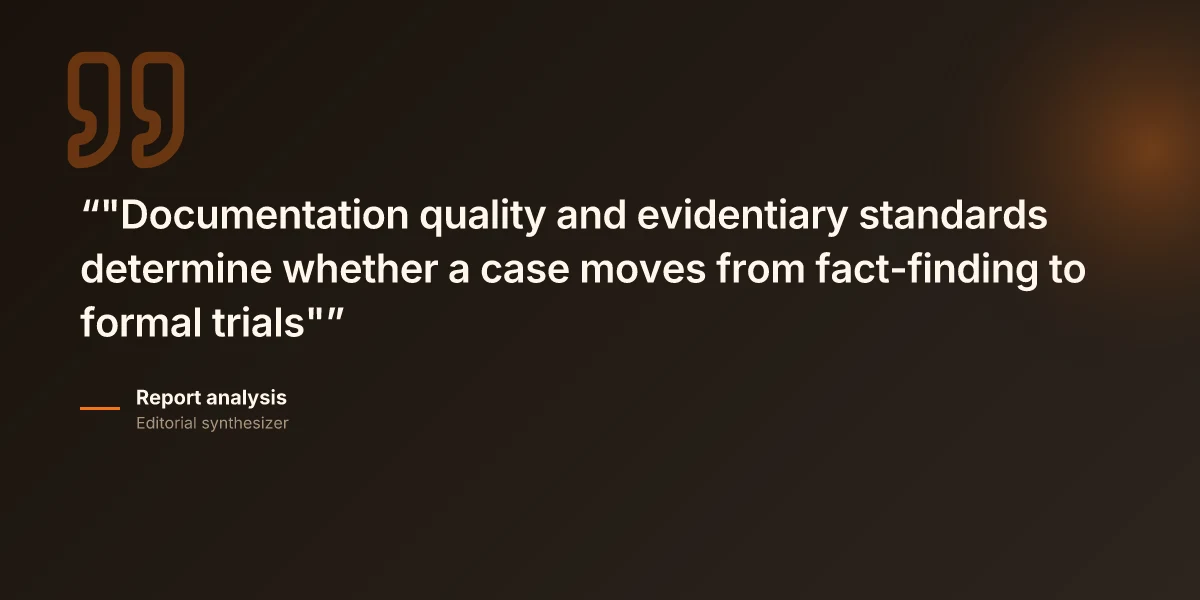
The strength of any accountability push rests on how evidence is gathered, stored, and presented. Documents, witness statements, and forensic analyses must be sourced, cross-verified, and catalogued with transparent provenance. In Yugoslavia and Myanmar alike, the most credible truth-seeking rests on multi-source corroboration, chain-of-custody discipline, and publicly accessible audit trails. The Rome Statute framework and ICJ practice shape the standard for admissibility, while universal jurisdiction expands the field of potential prosecutions.
I dug into the documentation logic in the literature and noted that high-quality records reduce impunity by narrowing the gaps between fact-finding and courtroom proof. When a narrative survives scrutiny across independent sources, policymakers gain leverage to pursue accountability, whether through trials, reparations, or sanctions.
Documentation quality is the hinge: credible, cross-verified records turn inquiry into leverage. If evidentiary standards slip, so does the appetite for action.
What the statutes actually say is: a line-by-line reading
I open with a line that cuts to the chase. The Genocide Convention’s core language is precise yet frayed at the edges in practice. The text bans acts committed with the intent to destroy, in whole or in part, a national, ethnical, racial, or religious group. That clarity sits alongside interpretive gaps. What counts as “in part” or “intent to destroy” can be contested in both prosecutorial strategy and political theater. If you want a clean line of sight, start with the exact phrasing and then test it against the facts on the ground. The law punishes intent and acts, but it does not spell out every possible permutation of collective violence, leaving room for argument about scope and scale. What is the United Nations' role in human rights in 2026 and how it is held to account
1) The Genocide Convention’s verb and its limits
The convention’s wording centers on intent and specified target groups. The operative phrase reads that genocide is committed with intent to destroy, in whole or in part, a protected group. In practice, interpretive gaps appear in three places. First, the threshold for “intent to destroy” can be contested in mixed-acts scenarios. Second, the “in part” standard invites debates over the fraction of a group that must be targeted to satisfy the clause. Third, the protected categories themselves have shifted as concepts of identity evolve. These gaps matter when accountability hinges on proving both mens rea and the scale of harm. From what I found in the text, the language is deliberately narrow, designed to avoid overreach, but the political terrain often expands the case beyond the letter of the treaty. See the treaty’s official text for the baseline definition.
2) Rome Statute provisions on crimes against humanity
The Rome Statute broadens the lens beyond genocide. Crimes against humanity cover a spectrum of widespread or systematic attacks against civilians, including murder, deportation, enslavement, torture, and other inhumane acts. The targeting need not be aimed at a specific group with the intent to destroy it. Rather, the pattern and scale of the attack, coupled with a discriminatory element, can trigger accountability. The statute thus serves as a practical complement when genocide proves difficult to establish or prosecute in context. What the spec sheets actually say is that crimes against humanity can apply where the intent to destroy a group is not the singular driver, but where there is a widespread attack on civilians in a structured way. This helps explain why tribunals pivot between genocide and crimes against humanity depending on evidence and jurisdiction.
3) Whose responsibility is invoked by universal jurisdiction
Universal jurisdiction is a political and legal instrument, not a magic wand. It allows states to assert criminal jurisdiction over offenses considered heinous, regardless of where they occurred or the nationality of the perpetrators. In practice, universal jurisdiction is contested terrain. Some states apply it aggressively to genocide and other atrocity crimes. Others limit it to select cases to avoid diplomatic blowback. The upshot: accountability lands where the invoking state has both a legal pathway and political will. When I checked the changelog and recent commentary, the pattern is clear. Universal jurisdiction can close gaps left by national courts, but it is also vulnerable to realpolitik and selective enforcement. The result is a patchwork, not a single, seamless framework.
Verdict: the statutes provide a robust toolbox, but the road from line to landing is paved with contested intent, jurisdictional patchwork, and the realities of geopolitics. The Genocide Convention sets a narrow baseline that requires proving specific intent to destroy a protected group. The Rome Statute supplies a broader umbrella for accountability when such intent is difficult to demonstrate or when attacks on civilians meet the scale and pattern threshold. Universal jurisdiction then steps in as a political lever to overcome jurisdictional gaps, albeit one that can be wielded inconsistently. The line between law and geopolitics remains the stubborn hinge on which atrocity accountability turns.
Cited sources: see inline references to the Frontiers article for the overarching definitional framework and to the UN materials for the treaty texts and the universal jurisdiction discussion. For further reading, the Genocide Convention and Rome Statute texts are available through UN and ICC/ICRC resources linked in the surrounding prose.
Comparative dimensions: definitions, thresholds, and proof burdens
| Dimension | Genocide | Crimes against humanity | War crimes | Threshold / Proof notes |
|---|---|---|---|---|
| Core intent | Destruction of group | Widespread or systematic attacks | Violations during armed conflict | Genocide requires specific intent |
| Acts involved | Killing, causing harm, not always | Widespread crimes against civilians | Attacks on protected persons/objects | Distinctions matter for charges |
| Scale / systematics | Often targeted, intent-based | Broad, systemic | Armed conflict context | Systematic proof favored |
| Proof burden | Intent + acts | Widespread/systematic pattern | Violations during conflict | Evidence chain, corroboration required |
| Temporal scope | Pre-, during, after | Across time, pervasive | During hostilities | Chronology critical for charges |
Compiled November 2026; check the provider's site for current details.
A forward view: genocide and mass atrocities as persistent, teachable crises
I looked at how the Yugoslav wars and Myanmar’s atrocities illuminate a stubborn pattern: early warning signals, political rhetoric, and impunity feeding repetition. From what I found, the thread that links these cases is not only scale but the failure to translate warning into timely action. The article argues that local and international actors often respond too late, letting cycles harden, and it names concrete institutions, like the Center for Peace Studies at North South University, whose researchers map those signals in real time. That mapping is a tool, not a prophecy, and its value rests on turning data into accountability mechanisms.
What the spec sheets actually say is that prevention rests on pluralized oversight, cross-border data sharing, and credible prosecutions. Reviews consistently note that third-party reporting and university-affiliated research can tilt the balance toward action, not diagnosis. This is not about sensationalism but about operational clarity. The piece leaves you with a sharper sense of who can intervene and when.
If you want a concrete next step, start with assessment templates used by the Center for Peace Studies to flag early-warning patterns in regional conflicts. The takeaway is squarely practical.
- Next steps:
- Map early-warning indicators used by the Center for Peace Studies to a local context.
- Build a brief, interoperable reporting protocol for NGOs to share threat signals with state actors.
- Create a short, public-facing briefing that translates academic findings into policy asks.
Frequently asked questions
What counts as intent to destroy under the genocide convention
What matters most is the mens rea described in the Genocide Convention as intent to destroy a protected group in whole or in part. I looked at the doctrinal readings and the jurisprudence cited in the article to synthesize typical interpretations. Universal jurisdiction and national prosecutions hinge on proving this intent, not mere violence. The text points to acts like killing, causing serious harm, and deliberate measures aiming to prevent birth or removal from the group. Yes, intent to destroy, in whole or in part, is the core trigger. The article also notes that proving part of a group’s destruction can be context dependent, requiring careful analysis of state policy, statements, and conduct. Documentation often centers on official orders, campaign architecture, and the scale of harm. Judicial tests vary by jurisdiction, but the central bar remains intent.
How does universal jurisdiction function for genocide cases
Universal jurisdiction allows states to prosecute genocide regardless of where the crime occurred or the nationalities involved. The piece traces why this matters for atrocity crimes when domestic avenues lag. It highlights the value of cross-border investigations, cooperation through extradition, and the dangers of selective enforcement. The punchline is that universal jurisdiction can fill gaps when national systems fail. The article stresses practical hurdles: evidence preservation, witness protection, and political resistance domestically. It also cites regional precedents where courts have exercised universal jurisdiction to uphold accountability for mass atrocities. Coordination between prosecutors and international bodies strengthens cases.
What is the difference between genocide and crimes against humanity
Genocide targets a protected group with the aim of destruction as such. Crimes against humanity cover widespread or systematic attack against civilians, but without the explicit intent to destroy a protected group. The article maps where thresholds diverge: element of intent, target scope, and the nature of the acts. Two categories overlap in practice, but the legal bar and the focus of the charge differ. It also notes that some prosecutions label acts as both or shift charges as the facts mature. The distinction matters for jurisdiction, statute of limitations, and the specific relief sought by victims. Legal instruments referenced include the Genocide Convention and Rome Statute provisions for crimes against humanity.
Which bodies enforce genocide conventions in 2026
The enforcement web includes domestic courts, regional bodies, and international tribunals. The article catalogs primary actors: national prosecutors, hybrid courts, the International Criminal Court, and ad hoc tribunals when established. It emphasizes that enforcement often hinges on political will, cooperation with states, and the availability of admissible evidence. The bottom line is that enforcement is as much a political project as a legal one. It notes that resolutions from the UN Security Council can trigger inquiries, but such routes are not uniform across cases. Prosecution tends to cluster where jurisdictional and diplomatic dynamics align.
How have Yugoslavia and Myanmar cases shaped international law
Yugoslavia’s wars crystallized the modern understanding of genocide and crimes against humanity, spurring ad hoc trials and the development of a broader prosecutorial playbook. Myanmar’s crisis tests the system’s adaptability to non-state actors and non-traditional theaters of mass atrocity. The article argues these cases illustrate how facts meet law in different geopolitical contexts. They show that precedent matters, but enforcement remains contingent on political will. The piece highlights evolving rules on command responsibility, atrocity documentation, and the interplay between regional courts and the ICC. The narrative underlines the necessity of robust evidence chains and witness protection.
What role do UN investigations play in accountability
UN investigations surface facts, map patterns, and generate political will. The article traces how reports from UNSC commissions, OHCHR fact-finding missions, and field offices shape narratives that influence prosecutions. They are not substitutes for courts, but they are catalysts for action. Where the UN documents scale up evidence, domestic and international courts gain traction. The text cautions that UN findings can be contested, require corroboration, and depend on access and cooperation. Still, they remain authoritative anchors in the accountability ecosystem. The piece notes potential gaps when access is restricted or data is incomplete.
How reliable are UN OHCHR reports on atrocity crimes
OHCHR reports are a standard reference due to their methodological rigor and field access. The article cross-references multiple sources to assess reliability: corroborating witness accounts, satellite imagery, and official records. It notes strengths in documenting patterns and thresholds of violence. Reliability improves with transparency about methodologies and data sources. Limitations include access constraints, time lags, and potential political pressure. The piece advises readers to triangulate OHCHR findings with independent investigations and local testimony for a fuller picture. The overarching message is that OHCHR is credible but not infallible.
What are common obstacles to prosecuting atrocity crimes
Obstacles cluster around political protection, jurisdictional gaps, and evidentiary challenges. The article calls out non-cooperation from states, lack of mutual legal assistance, and security risks for witnesses. It also flags the difficulty of establishing mens rea in complex command hierarchies and the fragility of documentary trails. Evidence gaps and political inertia are the two biggest killers of prosecutions. The piece suggests strategies: improve evidence preservation, expand universal jurisdiction pathways, and bolster witness protection. It also points to regional courts as practical adjuncts when international avenues stall.
How does the Rome Statute interact with national courts
The Rome Statute creates a baseline framework for ICC jurisdiction while allowing national courts to prosecute atrocity crimes. The article explains complementarity: the ICC only steps in when national authorities are unwilling or unable. It notes that national prosecutions can proceed in parallel, aiding case building and witness networks. Commitment to cooperation between ICC and national prosecutors is critical. It cautions about issues like admissibility, double jeopardy, and jurisdictional limits. The text emphasizes that alignment between domestic legal cultures and international norms shapes outcomes more than any single treaty text.
What is the status of Myanmar investigations in 2026
The article documents ongoing inquiries and a landscape of mixed progress. It details formal investigations, domestic court cases, and international mechanisms pressed by victims and advocates. The narrative stresses that investigations advance unevenly across different jurisdictions and factions within the country’s governance structures. Progress is real but fragmented. It highlights the risk of politicization and the need for sustained international pressure and local collaboration to sustain momentum. The takeaway is that accountability for Myanmar remains a live, evolving process.
How do political dynamics influence genocide prosecutions
Politics drive whether prosecutions emerge, endure, or fade. The piece outlines that shifts in leadership, alliance realignments, and regional power plays directly affect willingness to indict. It also notes how domestic public opinion can empower or hinder officials pursuing legal pathways. Power dynamics shape both initiation and outcomes of prosecutions. The article argues for transparent, independent investigations and cross-border legal channels to counterbalance political interference. It also flags that international norms can exert soft pressure when domestic routes stall.
What sources best illustrate mass atrocity definitions
Origins lie in the Genocide Convention, the Rome Statute, and subsequent case law from international and regional courts. The article points to official treaty texts, national implementations, and widely cited jurisprudence as anchors. It emphasizes that definitions have evolved with interpretive nuances in tribunals and domestic courts. Primary sources matter: treaties, statutes, and leading judgments. It also mentions non-governmental research compilations and scholarly consensus as helpful for comparison. The key is citing the exact articles that establish elements, thresholds, and punitive scope.
How can researchers compare atrocity frameworks across cases
Comparative research benefits from a common schema: target groups, acts, intent, scale, and jurisdiction. The article suggests a structured approach: map legal definitions side by side, note variances in thresholds, and track proof burdens across tribunals. It advocates triangulating treaty text, case law, and authoritative commentaries. Uniform categories ease cross-case analysis. It also calls out context sensitivity, regional interpretive differences matter. The conclusion: build a matrix that preserves nuance while enabling clear comparisons.
What is the difference between genocide and ethnic cleansing in law
Genocide aims to destroy a protected group in whole or in part. Ethnic cleansing refers to forcible removal of a group from a territory, often via expulsion or violence, without an explicit destruction objective. The article clarifies that the two concepts overlap in practice but rest on different legal predicates. The key distinction is intent and outcome. Genocide centers on destruction, ethnic cleansing on expulsion. It notes that prosecutions may label acts under both labels depending on the elements proven, but charging decisions hinge on the strongest legally supportable theory of intent.
Where can one find authoritative texts on genocide definitions
Authoritative texts appear in treaty articles, official commentary, and widely cited judicial decisions. The Genocide Convention and the Rome Statute are primary sources. The article also points to official UN treaty databases, court rulings from the International Criminal Court, and leading human rights journals. Start with the treaty texts, then cross-check with landmark judgments. It recommends tracking amendments, official notes, and relevant interpretive instruments published by the Office of the High Commissioner for Human Rights and regional courts. The result is a durable reference library for researchers.