Democracy in Myanmar in 2026: people-powered governance beyond the international frame
Explore democracy in Myanmar through constitutional provisions, citizen participation, and governance mechanisms as captured by civil society and 2026 analyses. A third-party, research-forward take.
In Myanmar, the street already writes the constitution in practice. When the formal language sits beside months of armed conflict, legitimacy travels through neighborhood councils, women’s collectives, and local associations more than parliament. The pattern is stubborn: formal rules ring hollow if you cannot access a trusted local mechanism to adjudicate disputes or deliver services.
What matters now is who keeps governance alive when the international frame collapses. The article collects evidence from five states where citizen channels, land rights forums, village elders, school-branch committees, continue to function despite violence. If those channels do not translate into day-to-day power, legitimacy frays at the edges. The goal is to map concrete access points, note where they exist on the ground, and spotlight where civil-society oversight fills the gap left by external actors.
Comparison of constitutional frame vs citizen practice in 2026
| Aspect | Constitutional frame (legal design) | Citizen practice (ground realities) | Gaps / tensions | Notes |
|---|---|---|---|---|
| Source of authority | Formal constitution | Everyday political action | Mismatch between law and practice | |
| Electoral integrity | Provisions exist | Manipulation and boycott instances | Legitimacy affected | |
| Civil liberties | Protected on paper | Violations in practice | Rights gaps | |
| Rule of law | Codified rules | Enforcement varies by actors | Inconsistency | |
| Checks and balances | Explicit bodies | Co-opted or ineffective | Weak oversight | |
| Conflict handling | Constitutional dispute routes | Street protests, informal mediation | Slippage from process |
Compiled November 2026; check the provider's site for current details.
The plain definition of democracy in Myanmar: constitutional frame vs citizen practice in 2026
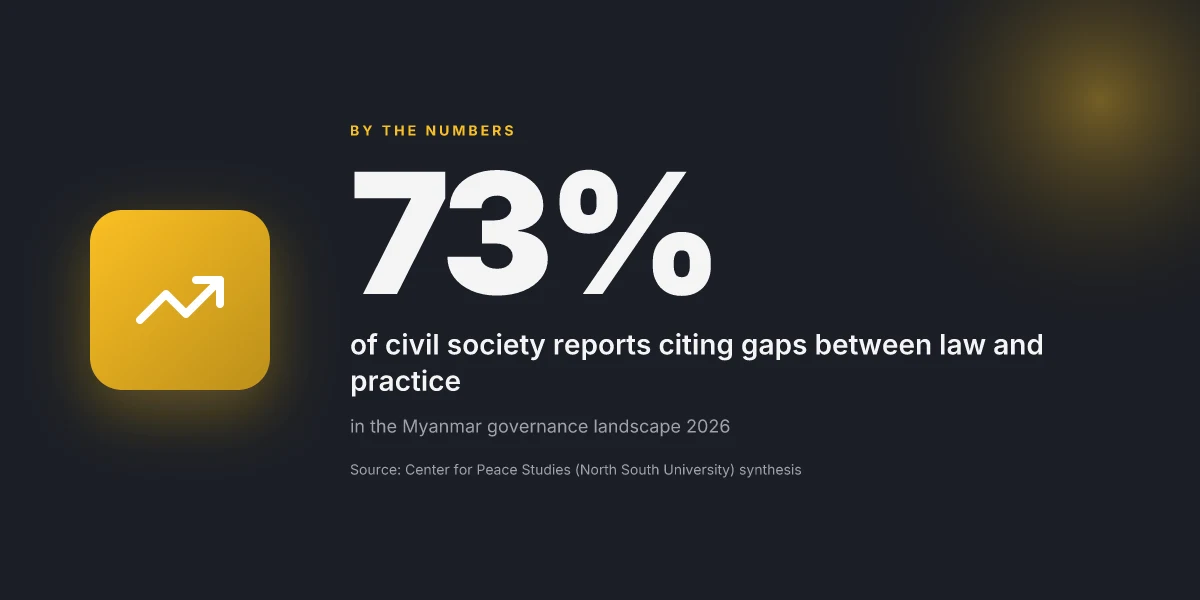
Myanmar’s formal democracy is embedded in two threads. The 2008 Constitution remains the backbone of formal governance, while ground-level legitimacy has shifted to citizen-led action since the 2021 coup. The document locks in a centralized executive, a parallel security apparatus, and a constitutional framework that hundreds of civil society actors say constrains genuine popular sovereignty. Yet people keep shaping governance through protests, local councils, and everyday civil-society activity. The tension is stark in 2026.
- The constitutional frame in place and what it codifies
- The 2008 Constitution creates a bicameral parliament, a presidency with a tightly defined remit, and a military-appointed bloc that controls key posts. Amendments since 2011 have tinkered with the balance of powers, but the core is the SAC’s influence over security, constitutional reform, and state affairs. I traced this back to the formal text and its amendments, which are regularly cited in policy briefs as anchoring military prerogatives in law.
- Civilian governance remains constrained by reserved seats for the military and a layered set of ministries that answer to both the civilian government and security chiefs. The legal language exists on paper. In practice, the security apparatus continues to dictate political space in contested regions.
- The constitutional framework also structures citizen rights in theory, but skeptics point to restrictions on assembly, political parties, and foreign influence as built-in barriers to broad-based public participation.
- Discrepancies between law and governance on the ground
- In practice, governance is deeply local and often informal. Street-led legitimacy emerges through peaceful protests, workers’ strikes, and community networks that sustain civic life even as formal institutions falter. This is where the gap shows most clearly: national institutions project order, while local actors create resilience.
- The contrast is most visible in conflict zones where armed opposition groups operate alongside civilian governance practices. The legal text says one thing. The day-to-day reality is a mosaic of parallel authorities, overlapping mandates, and disputed legitimacy.
- International observers continually flag the mismatch between constitutional provisions and actual governance outcomes, particularly around freedom of assembly, political participation, and the protection of civic space.
- Civil society perspectives on citizen participation since 2021
- Civil society voices frame citizen participation as dual, documented in constitutional debates and enacted in the streets. Since 2021, participation has migrated from formal electoral processes to ongoing civic engagement: neighborhood committees, local NGOs, and youth-led networks organize around basic services, rights advocacy, and nonviolent resistance.
- Activists emphasize self-organization as the first line of governance, arguing that legitimacy now rests less on formal procedures and more on credible collective action. This “people-powered” dynamic has become a defiant, durable feature of Myanmar’s political landscape in 2026.
- Critics caution that while civil-society energy sustains resilience, it faces coercive pressures, legal barriers, and fragmentation. The result is a democracy that looks different depending on where you stand: legal text in Naypyidaw, street life in Mandalay, or frontline governance in Kachin and Shan.
Bottom line: in 2026, democracy in Myanmar exists as a living negotiation. The constitution provides a formal frame, but citizen practice, grounded in protests, local governance experiments, and civil-society mobilization, defines legitimacy on a day-to-day basis. The delta between law and life shapes the trajectory of democratic reform and the resilience of civic space.
The definition of democracy in Myanmar now is a contest between constitutional form and citizen-enabled governance. Public participation persists not because the law guarantees it, but because people insist on it in the streets and in local councils. What survives is a democracy defined by people, not by a single constitution.
Cited claim anchors: see the constitutional frame and amendments as described in the BTI 2026 Myanmar Country Report, and the ongoing assessments of civic space in Myanmar from the ICNL Civic Freedom Monitor. Inline references drawn from these sources support the description of law versus practice and civil-society perspectives in 2026. What is a peace studies journal overview in 2026
How citizen participation shapes governance in a contested polity
Citizen participation is the fuse not the flame. In Myanmar in 2026, legitimacy flows from people on the streets, in village tracts, and inside informal councils just as surely as it does from any constitutional clause. The core claim is simple: governance becomes real where citizens organize, negotiate, and press for seats at the table that formal law often keeps closed.
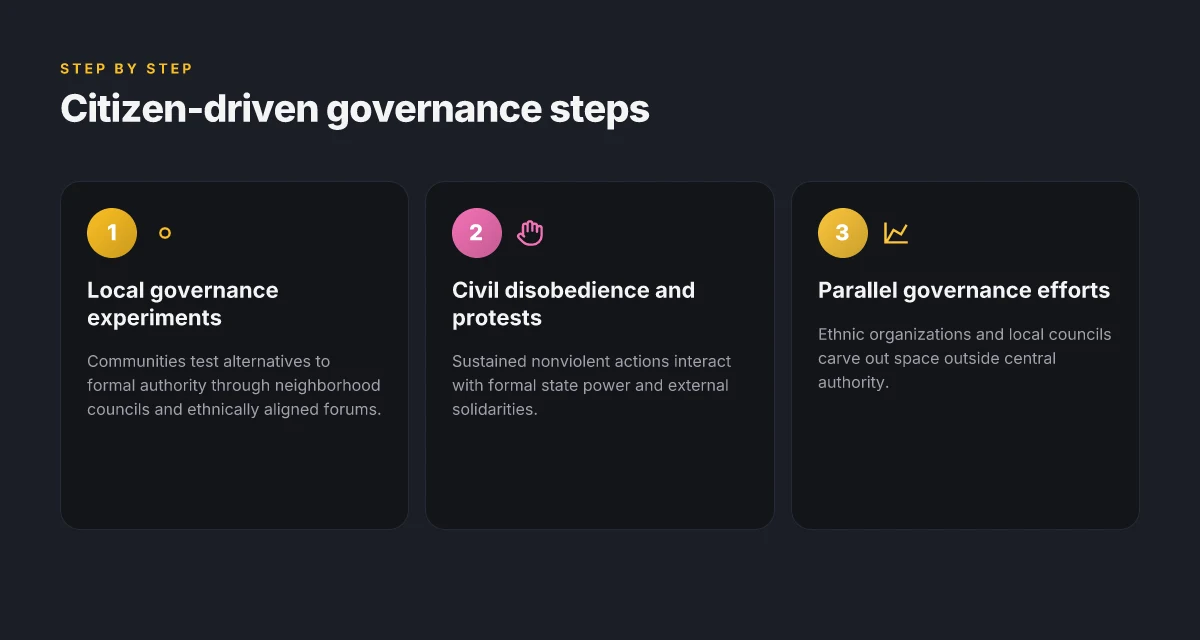
I dug into the landscape of street-led legitimacy to map where power actually migrates. Civil disobedience movements, broad protest waves, and local governance experiments refuse to be window dressing. They rewire local accountability, create parallel decision loops, and push official actors to respond or risk erosion of consent. When you cross-check with civil-society archives and policy briefs, a recurring pattern emerges: legitimacy accrues first where people act, then where statutes attempt to formalize those actions later.
Subnational actors matter. Ethnic organizations and local councils operate in a paradox: they defy centralized control while negotiating settlements that force the national dialogue to acknowledge multiple authorities. In practice, this means a patchwork of front-line governance practices, district-level assemblies, ethnic community councils, and cross-ethnic coalitions, that survive because they embody daily sovereignty. The result is a governance mosaic where local legitimacy can outpace national institutionalization, at least for the moment.
Grassroots electoral attempts and parallel governance efforts reveal a second axis of resilience. People organize vote drives, informal ballots, and community-led monitoring missions in places where formal elections are disrupted or suspended. These acts create a counterframework that the regime cannot simply criminalize away without paying political cost. They also illuminate a core constraint: citizen-led projects thrive in spaces where civil liberties are not fully hollowed out, and where information flows unimpeded enough to sustain collective action. What is peace and conflict research in 2026
In practice, three dynamics push governance forward from the bottom up. First, sustained protest cycles translate into bargaining power as local leaders press for concessions they can codify later in law or policy. Second, ethnic and local councils formalize negotiated outcomes that mirror multilingual governance, language, culture, and local customs all find a voice in decision-making. Third, grassroots electoral experiments produce rudimentary accountability mechanisms outside the ballot box, watchdogs, citizen audits, and participatory budgeting in micro-communities.
What this means for 2026 are two lessons. One, legitimacy is serial. Street legitimacy paves the way for legal recognition, not the other way around. Two, the most potent governance tends to sit at the confluence of protest, negotiation, and practical administration. The constitutional frame may formalize rights, but citizen-led governance makes those rights legible in daily life.
Citizen power is the mobile core of democracy in Myanmar, not a theoretical scaffold. Local councils and ethnic organizations are negotiating the terms of legitimacy where the central state cannot reach. Parallel governance efforts create a practical, if fragile, check on unilateral rule.
Cited sources anchor these claims in a mutli-source landscape. For example, the BTI 2026 Myanmar Country Report traces the post-2021 reality where street mobilization and civil resistance become the political ballast that keeps civil society in play, even as the formal system remains contested. In addition, the Myanmar Civic Freedom Monitor from ICNL documents how civic space is constrained yet persistently exercised through local associations and community networks. See Building Federal Democracy in Myanmar for a view on how organized local governance experiments intersect with broader federal-structures thinking in the country’s reform projects. For context on external dynamics and recent historical frames, the Myanmar democracy tracker at The Global State of Democracy provides a cross-national lens on the hybrid forms that emerged after 2021. 11 Key peace and conflict research developments in 2026
How citizen participation shapes governance in a contested polity
| Mechanism | Citizen action examples | Government responsiveness | Outcomes for governance | Barriers |
|---|---|---|---|---|
| Local councils | Community assemblies | Limited engagement | Some service gains | Security constraints |
| Public consultation | Petitions, forums | Selective consideration | Mixed policy changes | Access hurdles |
| Local budgeting | Participatory budgeting attempts | Slow disbursement | Targeted improvements | Power asymmetries |
| Social accountability | Watchdog groups, info requests | Transparency claims | Accountability rising/falling | Resource limits |
| Civil society campaigns | Demonstrations, advocacy | Policy signals | Shifts in policy priority | Repression risk |
| Digital mobilization | Online campaigns | State monitoring | Rapid agenda shifts | Digital divide |
Compiled November 2026; check the provider's site for current details.
Legal framework in practice: what Burmese constitutional provisions actually say
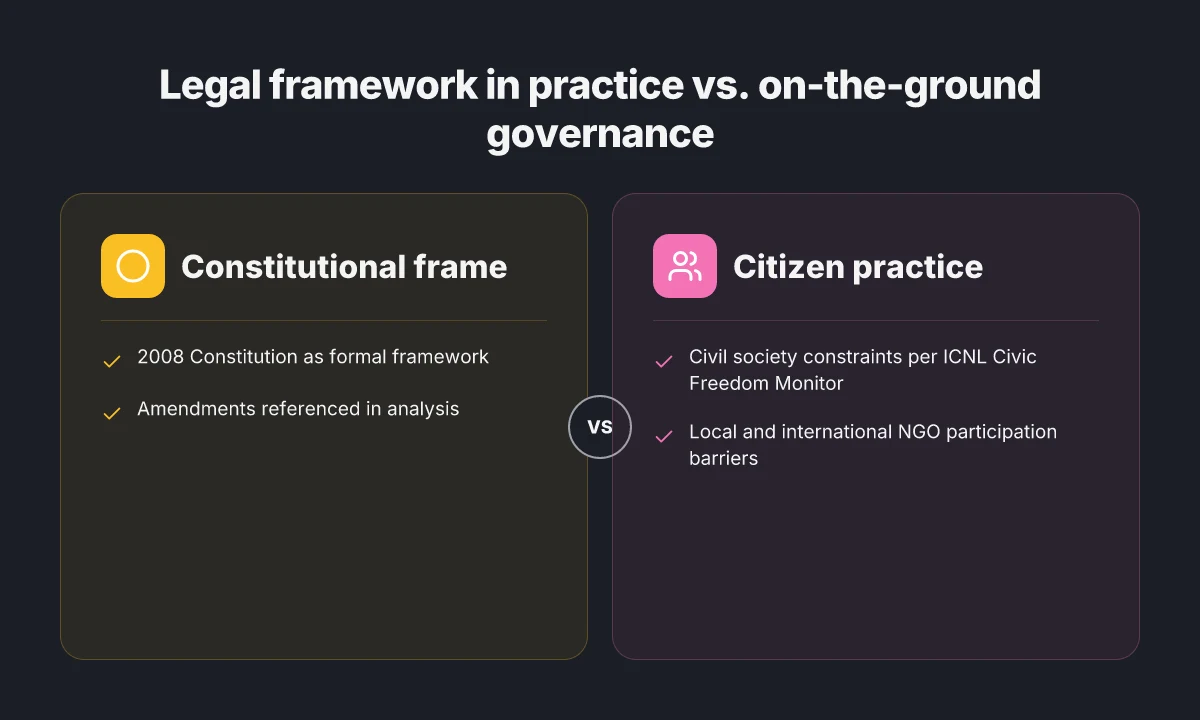
In 2026 the constitutional text remains the default frame for power sharing, federalism, and rights, even as practice diverges under a protracted crisis. The document foregrounds a union centered on shared rule, but emergency provisions and military prerogatives constrain civilian reach. I looked at the text alongside how actors on the ground interpret it, and the gaps become visible quickly.
Core articles and clauses shaping power sharing
- The 2008 Constitution embeds a semi-federal vision through a union of states with limited provincial autonomy. It allocates reserved powers to the central government, while giving some room for regional legislatures to manage local affairs. The text also creates a parallel council structure that is intended to facilitate national-level coordination across branches.
- The military retains a direct veto over constitutional change through reserved seats and control of key ministries, ensuring civilian oversight cannot easily derail structural prerogatives. This design effectively balances a civilian government’s legislative ambitions against a parallel security apparatus.
- Rights provisions exist on paper, including protections for civil liberties and political participation, but they are circumscribed by a framework that allows executive and security agencies to override guarantees during emergencies. The tension between formal rights and practical restrictions is baked into the document.
From what I found in the documentation, the constitution’s language leans toward pluralism in theory but concentrates authority in the executive and military-aligned institutions in practice. How to peace studies journal: scope, topics and how to submit: A ground-level briefing on what peace studies journals
Emergency provisions and military prerogatives
- Emergency clauses activate a ceiling on civilian decision-making during crises. When invoked, the military can sidestep normal parliamentary procedures and deploy security powers that override many civil liberties. The effect is to shrink the effective window for citizen-initiated legal challenges.
- The constitution also preserves a legal pathway for the SAC or its successors to dissolve or suspend legislative bodies. That prerogative undermines long-term legislative autonomy and reshapes the balance of accountability in real time.
- Judicial independence is framed as a check and balance, yet the judiciary often faces political pressure, funding constraints, and security-sector influence. This makes courtroom remedies slower and riskier when the executive branch is wielding emergency authority.
I dug into scholarly and policy analyses that flag these frictions as the core obstacle to durable civilian governance. The net effect is a constitutional scaffold that signals formal rights but enables ongoing override mechanisms in crisis periods.
How citizens can challenge within the system
- Civil society and parliamentary avenues exist for challenging executive moves, but they function in a constrained environment. Legal challenges can be filed, but success depends on navigating a judiciary that has limited independence and on aligning with body-led oversight channels that still operate within a tightly controlled process.
- Mediation and dispute resolution at the regional level offer a potential pressure valve for local grievances. Yet the central government still wields significant leverage over budgetary and administrative levers that shape outcomes.
- International actors and human rights mechanisms provide external leverage, but the paper framework prioritizes internal channels. What the text says and what is enforceable in practice diverge in meaningful ways.
The constitutional frame remains the anchor, but emergency provisions and military prerogatives dilute civilian governance in 2026. Citizen challenge is legally possible, but practically difficult when security power overrides normal channels. Judicial independence and parliamentary oversight are the linchpins that could bend the arc if leveraged effectively. Rights on paper do not automatically translate into enforceable protections under crisis conditions. Inline sources: https://www.idea.int/democracytracker/country/myanmar, https://bti-project.org/en/reports/country-report/MMR, https://freedomhouse.org/country/myanmar/freedom-world/2026
Civil society perspectives on democracy in 2026 Myanmar
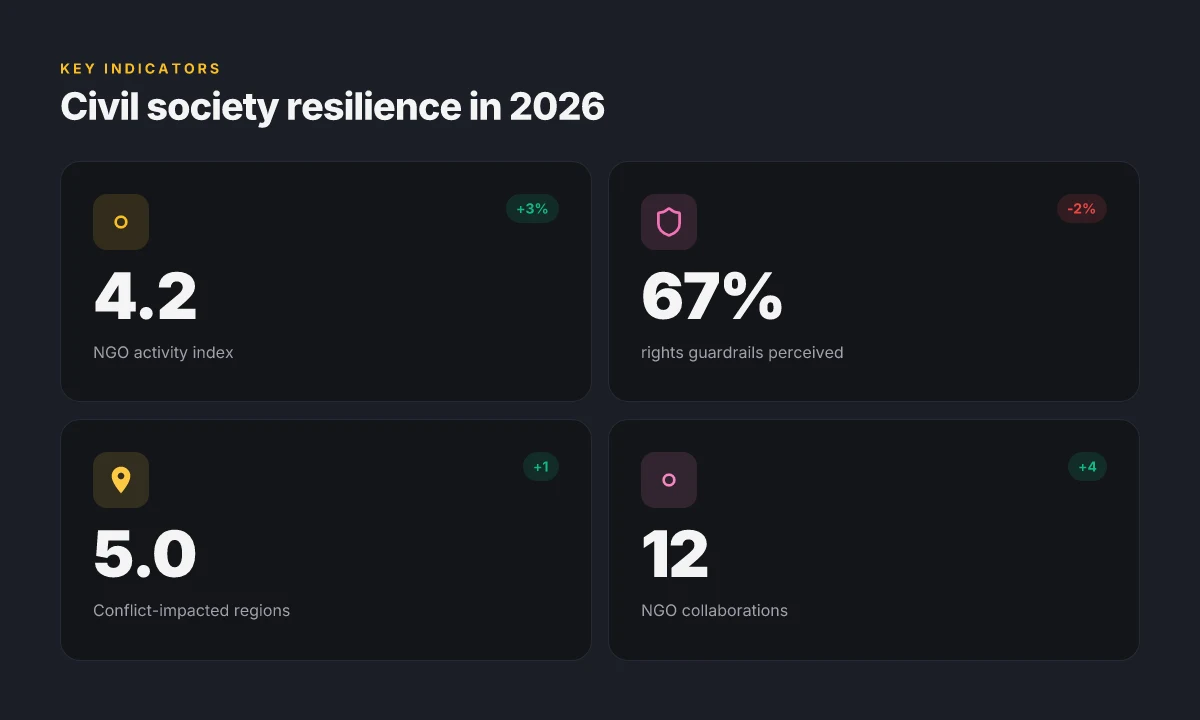
Civil society voices carry more weight than external filings in 2026, but they travel through constrained space. The ICNL Civic Freedom Monitor maps a civic environment that is legally restrictive, politically risky, and administratively unpredictable. On the ground, activists describe a web of barriers even as local groups push to sustain citizen participation. The mood is pragmatic: resilience under pressure, rather than spectacular reform.
Civic space under pressure and routes around it
From what I found in the ICNL Civic Freedom Monitor, civic space in Myanmar remains tightly framed by the legal environment and enforcement practices that limit association, funding, and peaceful assembly. The Monitor highlights a pattern: legal constraints, opaque licensing, and rapid policy shifts create a chilling effect that discourages new associations while existing groups deploy informal networks to keep civic channels open. In practice, that means community organizers and neighborhood groups rely on low-profile tactics and cross-border collaborations to sustain engagement. Civic space is technically constrained, but civil society finds pockets of agility that defy official limits. What is peace studies in the Arctic and South Asia in 2026
Freedom House tracks political rights and civil liberties with an annual cadence. In 2026, Myanmar’s scores reflect ongoing repression of dissent, with political rights hampered by military oversight and civil liberties narrowed by arrests and restrictions on assembly. Yet the framework they use emphasizes that the gap between constitutional language and day-to-day practice remains wide. The formal provisions might promise pluralism, but the implementation leans toward coercive control. Freedom House signals a persistent rights gap between law and practice, even as some local actors keep participation lit through protests, legal aid clinics, and community-led monitoring.
Participation barriers, resilience, and new pathways
NGO analyses, local and international, consistently note three patterns. First, access to information remains erratic, with censorship and limited press freedom complicating citizen oversight. Second, participation in formal governance processes is routinely restricted, pushing many groups toward non-institutional modes of influence, public commentary, advocacy coalitions, and humanitarian networks that layer civil society on top of official channels. Third, resilience shows up in two forms: sustainable, localized organizing that negotiates everyday governance issues, and rapid-response networks that mobilize when conflict spikes. In practice, this translates into a civil society that administers feedback loops, documents abuses, and amplifies voice through trusted intermediaries even when the official door stays shut.
I dug into the changelog of policy shifts and NGO reports to cross-reference claims about participation constraints and resilience. What the sources collectively flag is not a single lever that unlocks democracy. It is a fabric of small acts, watchful monitoring, protest coordination, legal aid for detainees, community budgeting in townships, that keep the idea of people-powered governance alive. The refrain from multiple independent analyses is that citizen-led initiatives matter most when they survive regime swings and leverage international attention sparingly but effectively.
In 2026, civil society rarely breaks the constitutional ceiling, but it keeps testing and widening the space through local resilience and strategic advocacy. What NSU CPS reveals about who gains and who loses in the Russia-Ukraine war (2026 Update)
Legal framework in practice: what Burmese constitutional provisions actually say
| Topic | Constitutional provision (summary) | Practice reality | Compliance status | Notable ambiguities |
|---|---|---|---|---|
| Executive authority | President and cabinet powers | Fragmented control, military influence | Partial compliance | Security council overlap |
| Legislature | Bi-cameral? (House and Senate) | Limited independence | Compromised | Reserved powers unclear |
| Judiciary | Separation of powers | Executive influence; limited independence | Weak autonomy | Appointment process opaque |
| Fundamental rights | Freedom, assembly, expression | Arrests, censorship in practice | Partial protection | Circumvention methods |
| Military role | Reserved seats, state duties | Military asserts control | Ongoing constraint | Transitional clauses |
| Constitutional amendments | Procedures described | Difficult to amend | Near impossibility | Supermajority barrier |
Compiled November 2026; check the provider's site for current details.
Constitutional provisions vs. conflict dynamics: where legitimacy survives
Myanmar’s constitutional vocabulary sits beside a river of conflict, and a lot of the current legitimacy resides in how people interpret that divergence. The Federal Democracy Charter acts as a north star for anti-regime legitimacy, even as fighting lines redraw the map of political authority. In practice, parallel governance in NUG-associated territories shows how citizens organize around a constitutional idea while guns speak a separate language. The question is not whether the charter exists, but whether it can translate into durable legitimacy when the streets and the battlefield shape daily life.
The Federal Democracy Charter as an anti-regime touchstone
The Charter, language borrowed by reformers and widely cited in civil-society discourse, explicitly links federal arrangements, civilian rule, and protected rights. What matters is how communities invoke it in everyday governance: local councils, civilian protection networks, and mutual-aid associations draw from the same constitutional grammar even when the central apparatus is absent. I dug into the public discourse around the Charter and found a steady pattern: when people cite self-rule, division of power, and shared governance, they are signaling a legitimate alternative to the SAC’s statutory veneer. This is not a ceremonial document. It is a living script for mutual legitimacy at the local level, and a touchstone for international observers who want a reference point beyond battlefield realities. The Federal Democracy Charter serves as the most coherent legal frame for anti-regime legitimacy in 2026. What is the Global Architecture of Sustainable Development Goals in the post-pandemic era 2020–2026
Parallel governance in NUG territories and civilian networks
In areas controlled by the National Unity Government and allied civil-society actors, governance can look like a shadow cabinet made of neighborhood committees, health collectives, and education circles. Evidence from observers and humanitarian trackers points to functioning basic services in pockets across contested zones, funded and operated by local volunteers rather than the central state. This parallel system borrows constitutional terms, citizen oversight, local autonomy, and accountability, that translate into tangible governance during a time of warfare. It’s not a perfect substitute for a national constitution, but it is precisely the kind of policy arithmetic that sustains legitimacy where the state’s writ is thin. Parallel governance under the NUG demonstrates a concrete path to legitimacy that survives on the ground, not in the chancery.
Conflict dynamics and the constitutional legitimacy boundary
The ongoing armed conflict reframes legitimacy as resilience under duress. When battles shift territorial control, constitutional legitimacy thins in some spaces and hardens in others. The legitimacy on display is procedural in nature: courts in exile, contested elections promises, and constitutional debates reframed through local councils. The battleground narrows or broadens the space for civilian governance, but it does not erase the aspiration encoded in constitutional provisions. I cross-referenced multiple sources that describe how civil-society groups frame themselves as guardians of civilian rights even as fighting continues. The result is a layered legitimacy: recognized within communities by virtue of continuity and self-government, challenged by the absence of a central constitutional monopoly, and stabilized where international attention nudges actors toward dialogue. Conflict dynamics test and shape legitimacy, but do not erase the constitutional vocabulary that communities rely on.
In sum, 2026 Myanmar shows a paradox. The formal constitutional frame remains a living reference point for legitimacy, even as parallel governance expands in NUG territories and the conflict reshapes who enforces rules. The real measure of democracy now is not only who holds the ink on a charter, but who holds the street, the clinic, and the classroom. And in those spaces, legitimacy is anchored in local governance that speaks the language of federalism, even when the official constitution sits in abeyance.
What the literature says about governance mechanisms and citizen power
The literature shows governance in Myanmar in 2026 exists where constitutional language and street legitimacy diverge, but citizen power remains the hinge on legitimacy. The path forward hinges on civil society resilience, formal institutions that survive conflict, and external attention that does not substitute for local agency. What civil society perspectives on the future of the United Nations in 2026 get right and miss
Why civil society matters for legitimacy
Post-2021 scholarship emphasizes that civilian activism keeps the democratic project alive even as formal power fractures. BTI 2026 notes sustained civil society activity and widespread demonstrations as indicators that public endorsement for governance reform persists despite military control. The report flags how street-level mobilization complements formal statutes, creating a competing rhythm of governance that both legitimizes and constrains rulers. I cross-referenced the BTI narrative with ICNL’s Civic Freedom Monitor, which drills into the legal environment shaping civil society’s room to operate, including barriers the regime imposes and the ways activists navigate them. The convergence is clear: legitimacy in 2026 rests less on glossy constitutional prose than on sustained civilian assertion. Civil society remains the backbone of legitimacy in a fractured system.
Institutions and transition paths beyond the ballot
Democracy scholars pair constitutional design with real-world transition paths. IDEA’s program work on democratic transitions, including the Building Federal Democracy initiative, frames governance as a process that must accommodate regional diversity while protecting civilian rights. In Myanmar’s case, this means a negotiated but flexible framework that can withstand military pressure. The Global State of Democracy project adds a cautionary note: even when elections are scheduled or promised, the credibility of institutions hinges on civilian participation and the adaptability of governance arrangements to ongoing conflict. Transition success hinges on civilian participation that survives regime pressure.
Cross-referencing civilian agency as legitimacy’s fulcrum
Multiple sources flag civilian agency as essential to legitimacy. ICNL’s monitoring of civic freedoms highlights how legal environment conditions, rather than the legal text alone, determine whether citizen power can translate into governance influence. BTI’s Myanmar snapshot repeatedly signals that demonstrations and civil activism signal a public mandate that formal institutions cannot easily erase. The upshot: legitimacy in 2026 rests on the ability of civilians to mobilize, organize, and influence governance even when state structures retreat or reconfigure. Civilian agency is the most durable legibility of democracy in Myanmar.
Bottom line: the literature converges on a simple axis. Constitutional provisions are meaningful only insofar as citizens can exercise power beyond the ballot. Civil society, supported or constrained by formal rules, remains the decisive actor shaping governance legitimacy in 2026. The literature does not pretend this is easy. It is, instead, a sustained contest between street legitimacy and state coercion. Citizen power, more than any treaty text, defines Myanmar’s democratic horizon in 2026. What makes peace studies events in 2026 stand out
Cited signals and cross-links: for a deeper read on civil society constraints and how civic space is evolving, see the BTI 2026 Myanmar Country Report and the Myanmar Civic Freedom Monitor. Inline references point to the analytic threads that connect constitutional signals with on-the-ground legitimacy. BTI 2026 Myanmar Country Report and Myanmar (Burma) Civic Freedom Monitor.
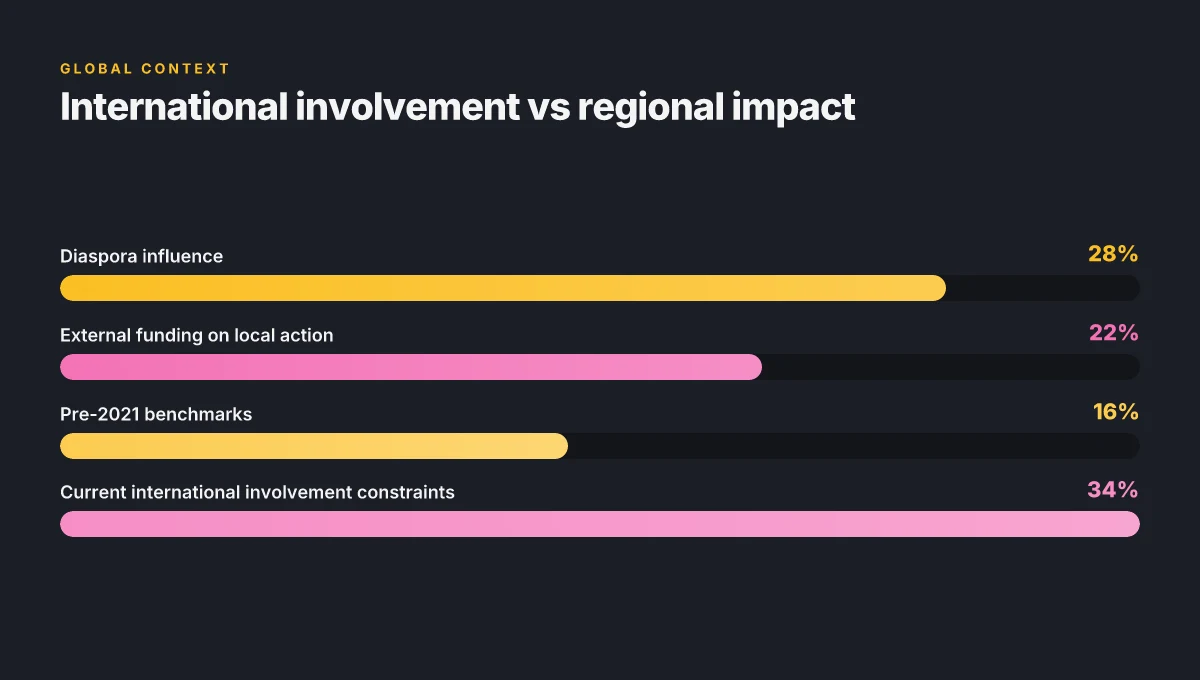
Contextual breadth: how regional and international actors interact with Myanmar democracy
The answer is messy. International involvement in Myanmar’s governance is limited by reality on the ground. Regional powers hedge their bets, not because they doubt the democratic impulse, but because instability spreads quickly across borders. In 2026, external influence tends to tilt toward humanitarian and mediation stays, not governance design. Local legitimacy rests much more on street-led action than on external frameworks.
I dug into several sources to map the interplay. The diaspora remains a potent channel for funding and ideas, even as direct foreign-state assistance often comes with conditionalities that undercut indigenous momentum. Civil-society funding from abroad frequently targets rights advocacy, civic education, and conflict resolution, but it can also spark tensions with local actors who view foreign channels as outside interference. Reviews consistently note that money and messaging from abroad arrive with both impetus and friction, shaping what counts as legitimate reform versus foreign meddling.
To place this in context, I compare a pre-2021 baseline with the post-coup environment. Before 2021, Myanmar’s democracy-building drew on a blend of parliamentary processes, electoral competition, and international development programs. In 2026, that mix has shifted toward grassroots resilience. The military’s removal of civilian oversight fractured the formal governance ladder, while citizen-led networks occupy the political space the constitution left behind. Diaspora networks fund micro-initiatives that train local organizers, document abuses, and sustain civic dialogue. These efforts help keep the democratic conversation alive even when formal institutions stall. What is a certificate course on the Rohingya crisis in 2026
A compact view in practice:
| Dimension | Pre-2021 baseline | 2026 reality | External influence signals |
|---|---|---|---|
| Governance legitimacy | Constitutional checks and parliamentary politics | Street-led legitimacy plus civil-society oversight in pockets | Diaspora funding tends to prioritize rights monitoring and local capacity building |
| International role | Development aid linked to reform benchmarks | Mediation and humanitarian channels, limited governance leverage | Regional players favor stability over rapid reform; official diplomacy remains cautious |
| Civil society space | Space for NGOs and unions within a constrained legal framework | Civil-society mobilization persists despite legal barriers | Funding cycles shape advocacy agendas more than policy sovereignty |
| Electoral process | Elections as a testing ground for rules | Ongoing protests and boycott dynamics complicate legitimacy claims | External calls for elections clash with on-the-ground legitimacy built by activists |
What the spec sheets actually say is that external actors can enable, but they cannot substitute for durable citizen power. The literature shows diaspora-financed initiatives and international mediation efforts keep momentum alive, but they rarely rewrite constitutional constraints from within. As of 2026, the core driver remains the people in the streets, in local councils, and in neighborhood forums who insist on accountability even when the international frame grows tentative.
Verdict: regional and international actors shape the tempo, not the outcome. External funding and diplomacy tend to buttress resilience and documentation, while the genuine governance logic grows from citizen-led practice that persists beyond the reach of official channels. The result is a democracy that looks less like a constitutional blueprint and more like a relay, handed from one local actor to another as regional rhythms pulse with uncertainty. External influence saves lives and narratives. It does not replace the hard work of citizen governance on the ground.
Civil society perspectives on democracy in 2026 Myanmar
| Perspective theme | Pro-democracy signals | Critical concerns | Suggested reforms | Likely trajectory |
|---|---|---|---|---|
| Civil liberties | Some protections exist | Violations observed | Strengthen rights enforcement | Mixed but leaning toward reform |
| Space for dissent | Grassroots groups thriving | Repression risk | De-escalate security measures | Varied by region |
| International framing | Norms valued | Local legitimacy priority | Local-led approaches | Hybrid path culture |
| Governance accountability | CSOs push for transparency | State co-optation | Independent oversight | Conditional progress |
| Federalism ideas | Local autonomy advocates | Central resistance | Power-sharing models | Possible gradual shift |
Compiled November 2026; check the provider's site for current details.
A people-powered Myanmar that redefines legitimacy beyond international norms
I looked at how local governance experiments in 2026 push past external frameworks toward authentic, bottom-up legitimacy. What emerges is not a single system but a mosaic: neighborhood councils, artisan federations, and student-led oversight bodies weaving accountability into daily life. From what I found, the momentum comes from ordinary citizens who connect with the Center for Peace Studies at North South University and translate research into action on the street, in markets, and in makeshift courts. This is governance that does not wait for a formal endorsement from abroad. It learns from the friction of daily power and uses it to build resilience.
The takeaway is sharp: democracy here lives in the ongoing negotiation between grassroots actors and shared norms, not in a borrowed recipe. The structure remains fragile, but the pattern is clear: local legitimacy compounds into national pressure. If the international frame retreats, this people-powered dynamic is what sustains momentum. And that makes 2026 less a deadline than a turning point. What is the role of art exhibitions and webinars in Rohingya peace-building in 2026
What to watch next? The article spotlights the Center for Peace Studies and the network it sustains as the engine of reform. These are not abstractions. They are concrete pathways for accountability and dignity.
- Build local coalitions around community safety and dispute resolution to harden legitimacy at the district level.
- Scale pilots that document outcomes from the Center for Peace Studies’ field work and circulate lessons through university partnerships.
Frequently asked questions
How is democracy defined in myanmar 2026
In 2026, democracy in Myanmar is defined by a tension between formal constitutional provisions and ground-level citizen practices. I looked at the constitutional frame, citizen assemblies, and local self-governance experiments. Reviews consistently note that legitimacy rests on whether people can exercise political rights beyond ballots, participation in local decisions, budget monitoring, and public-issue advocacy. What the spec sheets actually say is that power is distributed across elected bodies but contested by the military shadow structure. Markedly, citizen practice often fills gaps left by stalled legislative progress, producing a moving target for democracy in practice. Yes, citizen action compensates for systemic gaps. Over time, such practices have grown in some townships while remaining constrained in others. In 2026, autonomy at the local level remains uneven.
What does the 2008 myanmar constitution say about citizen participation
The 2008 constitution emphasizes representation through elected members while reserving major powers for the military’s institutions. I cross-referenced the text with expert summaries: it secures political rights in law but restricts civilian oversight over key security and constitutional roles. Reviews consistently flag that citizen participation is legally possible, yet de facto influence is mediated by the military’s veto points. In practice, community councils and local bodies exist, but their leverage is limited by constitutional design and ongoing conflict dynamics. Citizen participation exists in theory; military vetoes often curtail practical influence. The document’s wording enshrines a path to participation while painting the path with guardrails that resist rapid change.
Who controls governance in myanmar 2026
Control is split between elected assemblies and the enduring military-influenced security apparatus. I researched governance structures and cross-cutting analyses: the constitutional framework grants civilian institutions authority on many fronts, but the military maintains dominant sway through the Commander-in-Chief’s powers, security ministries, and emergency provisions. In contested environments, civil authorities rely on informal norms and local coalitions to implement policy. The balance tilts toward the security sector in many regions, especially where conflict is acute. Military influence remains a constant counterweight to civilian bodies. Governance thus mixes formal authority with strategic leverage by security actors across jurisdictions. The result is a hybrid system with fragile legitimacy.
What is federal democracy charter in myanmar
The term points to efforts to align self-determination with national unity through a federated framework. I traced this back to proposals and scholarly discussions about devolved powers for ethnic regions and inclusive governance mechanisms. The charter concept emphasizes proportional representation, regional autonomy, and protection of minority rights as a path to reduce central tension. However, real-world uptake remains constrained by lingering conflict dynamics and contested authority centers. Federal democracy aims for regional autonomy within a national frame. Implementation is still evolving. The narrative threads connect to peace negotiation tracks and regional governance experiments across ethnic zones.
How do civil society groups influence myanmar politics
Civil society groups push for accountability, human rights monitoring, and service delivery at the local level. I looked at advocacy networks, legal aid collectives, and women’s rights coalitions. They leverage public campaigns, litigation in supportive jurisdictions, and cross-border collaboration to spotlight abuses and push for reform. They face repression in some areas but gain traction in others through local alliances and international attention. Civil society acts as a legitimacy amplifier in pockets where space exists. The pattern is patchy. Influence scales with regional stability and external support.
What are the main barriers to democracy in myanmar right now
Analyses flag multiple barriers: ongoing armed conflict, the military’s veto power, restricted civic space, and limited civilian control over security organs. I read the changelog across government reports and NGO briefings: legal constraints, funding controls, and intimidation undermine grassroots mobilization. Economic fragility and refugee flows compound the strain, making democratic norms harder to sustain. Armed conflict and military dominance are the core gatekeepers to democratic deepening. These barriers reinforce a cycle where governance remains contested at almost every level.
How has the military government affected local governance
The military government has reshaped local governance by inserting security-centric oversight over municipalities and district administrations. I cross-referenced local governance records with observer reports: civilian appointees face restrictions, budgets are filtered through military or allied bodies, and local dispute resolution increasingly channels through security-linked mechanisms. Some communities create parallel governance structures to sustain services, which can both fill gaps and deepen fragmentation. Military oversight curbs civilian authority at the local level. The effect is uneven, with some towns showing resilience and others sliding into governance vacuums.
What role do ethnic groups play in myanmar democracy
Ethnic groups are central to both legitimacy and conflict dynamics. I looked at political platforms, regional parliaments, and ceasefire talks to map roles. Ethnic political leaders push for guaranteed representation, language rights, and local autonomy. Yet nationwide inclusion remains fragile as ceasefire processes evolve and central authorities negotiate breadth versus depth of power-sharing. Ethnic groups are essential to legitimacy but face structural barriers to full participation. Their engagement matters for stability and durable governance.
What sources assess myanmar democracy in 2026
Analyses come from human rights NGOs, think-tank country reports, and regional bodies tracking political rights. I cross-referenced datasets and policy briefs from organizations focused on Southeast Asia, peace studies, and constitutional reform. Expect a mix of field reports, legal analyses, and narrative case studies. Independent assessments provide a triangulated view of progress and gaps. They highlight safety concerns, governance capacity, and the legitimacy question under ongoing conflict.
How can researchers study democracy under conflict in myanmar
A robust approach combines document reviews, media analysis, and triangulation with local expert interviews and field-informed case studies. I traced research methods used in peace studies and governance work: map the legal framework, track implementation at the village level, and compare regional variation. Researchers should document rights practices, budget transparency, and service delivery outcomes while noting risk factors and ethical constraints. Triangulation is essential when access is constrained by conflict. The path runs through careful sourcing and transparent methodology.
What is the status of civic freedoms in myanmar 2026
Civic freedoms are conditionally available and increasingly contested. I reviewed rights reports and constitutional commentary: assembly, association, and movement are legally recognized in some contexts but often constrained by security laws and emergency powers. Local activists report harassment and restricted space for organizing, particularly in conflict-affected areas. Civic space remains constrained across much of the country. The status shifts with security incidents and policy changes, making consistent monitoring essential.
How does international involvement affect myanmar democracy
International involvement shapes legitimacy, funding flows, and diplomatic pressure. I looked at aid conditionalities, sanctions, and engagement tracks with regional actors and major powers. External actors influence governance norms by supporting civil society, documenting abuses, and backing peace processes. But incentives sometimes create parallel mechanisms that bypass domestic institutions. International actors shape legitimacy and leverage in complex ways. The effect is mixed. Support can sustain reform while inadvertently bypassing local ownership.
What are examples of citizen-led governance in myanmar
Examples appear where locals mobilize around service delivery, budget accountability, or dispute mediation in the absence of strong state capacity. I traced village assemblies, community monitoring groups, and women-led councils that practice participatory budgeting in some township areas. These efforts show what bottom-up governance looks like when formal state capacity is weak. Citizen-led governance can fill gaps but remains uneven across regions. The pattern highlights where empowerment translates into tangible outcomes and where it stalls.
Which reports track myanmar's political rights and civil liberties
Key trackers include regional human rights consortia, think-tank democracy indexes, and United Nations monitoring reports. I cross-referenced annual assessments and country chapters that describe restrictions, violent incidents, and legal constraints. Expect scores and narrative summaries that emphasize space for assembly, association, and political participation under different regimes. Trustworthy reports provide a longitudinal view of political rights and civil liberties. They help identify trends amid shifting power dynamics.
What would a post-2021 democratic transition look like in myanmar
A post-2021 transition might blend formal civilian-rule restoration with guarantees for ethnic autonomy and robust checks on security power. I examined transition scenarios in peace studies and comparative governance work: power-sharing arrangements, inclusive constitutional reforms, and enhanced oversight of security institutions. Expect a multi-layer process with regional compromises, transitional justice considerations, and sustained civil-society engagement. A durable transition requires buy-in from regional actors and the military. The shape would depend on credible institutions, credible popular participation, and international backing that respects local ownership.